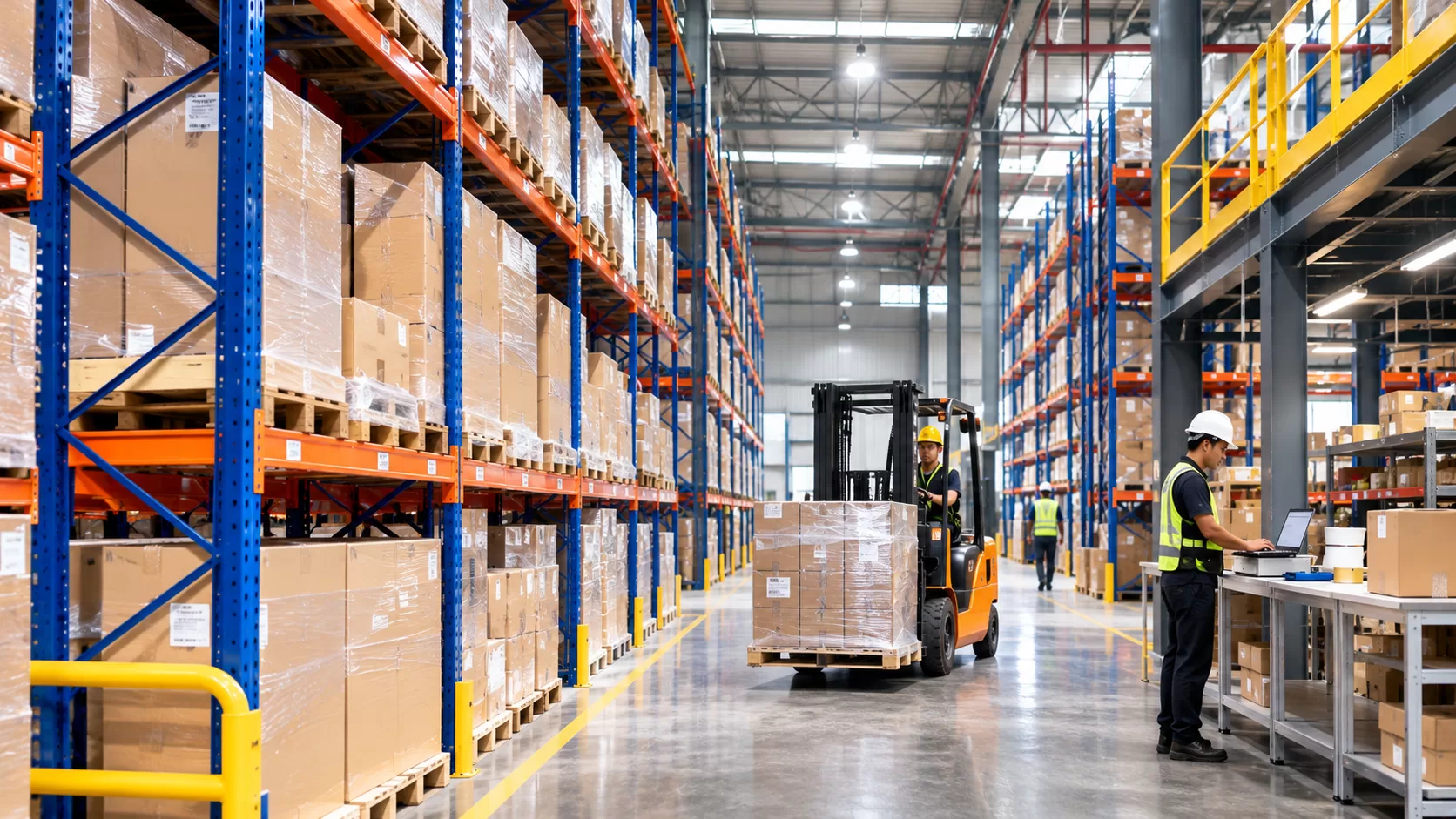
Distribution centre racking in Malaysia should be planned around how orders are picked, replenished and dispatched, not simply how many pallets fit inside the building. A facility handling full-pallet deliveries has different storage and traffic needs from a 3PL operation processing hundreds of mixed-SKU order lines each day. Both may use pallet racks, but the best combination of reserve storage, forward picking and dispatch space will differ.
This guide explains how logistics managers can translate order profiles into a practical layout. It covers pallet-reserve zones, pick faces, shelving options, replenishment capacity, safe forklift movement and the information to provide before requesting a racking layout. The numerical example is illustrative, not a measured performance claim or an engineered design.
For a general introduction to light-, medium- and heavy-duty storage types, first see MR Space’s storage racks Malaysia selection guide. Here we concentrate on the operational requirements of distribution centres, e-commerce fulfilment facilities and 3PL warehouses.
What Makes Distribution Centre Racking Different From General Warehouse Storage?
A distribution centre is measured by movement as much as by stored inventory. Receiving, put-away, picking, replenishment, packing and dispatch compete for time and floor space. A rack arrangement that delivers maximum theoretical pallet positions can still slow order processing if the pick face is inaccessible or replenishment trucks repeatedly block the same aisle.
Three questions help separate distribution centre planning from a basic storage quotation:
- What leaves the building? Whole pallets, cartons, individual pieces or a changing combination?
- How often does each SKU move? A product picked 40 times per day should not automatically share the same location strategy as a product picked twice per month.
- Who accesses each zone? Reach trucks may work in reserve storage while pedestrian pickers or pallet jacks work near packing stations. Their routes need deliberate separation where practicable.
MR Space’s range includes selective pallet racking, double-deep pallet racking and longspan shelving. These are relevant physical storage options, but warehouse management software, inventory data and operating procedures remain separate decisions. The racks themselves do not automatically allocate stock or schedule replenishment.
Start With the Order Profile, Not the Number of Rack Bays
Before drawing aisles, review a representative period of order and inventory data. A distribution centre should include a normal operating week and, where practical, a peak period. For a new facility without reliable history, mark volumes as forecasts and test more than one scenario.
A supplier can then evaluate the quantity and types of racks against the actual movement of goods. Useful inputs include the dimensions and weight of the heaviest loads, the height of complete pallet loads, how often an item is picked, the equipment used to handle it and the available clear height.
| Data to collect | Example information | Why it changes the layout |
|---|---|---|
| SKU and customer mix | Active SKUs, customer-specific segregation, returns, special handling | Decides whether stock needs many directly accessible pick locations. |
| Order-line velocity | Orders or lines per SKU per shift; peak-day patterns | Shows which SKUs need the easiest access and larger pick faces. |
| Handling units | Full pallet, carton, case or each; units per case | Determines pallet reserve versus shelving or piece-pick areas. |
| Load and dimensions | Maximum loaded pallet weight, footprint, height, overhang | Inputs for rated rack design, clearances and handling equipment. |
| Equipment and building | Forklift type and turning envelope, floor condition, door and column positions | Constrains aisle geometry and viable rack configurations. |
| Receiving and dispatch | Dock schedule, inbound/outbound peaks, staging duration | Protects working space rather than assigning every metre to storage. |
Planning tip: A racking quotation based only on warehouse floor area is incomplete. It can estimate potential rack locations, but not whether those locations support the intended fulfilment process.
Divide the Building Into Six Working Zones
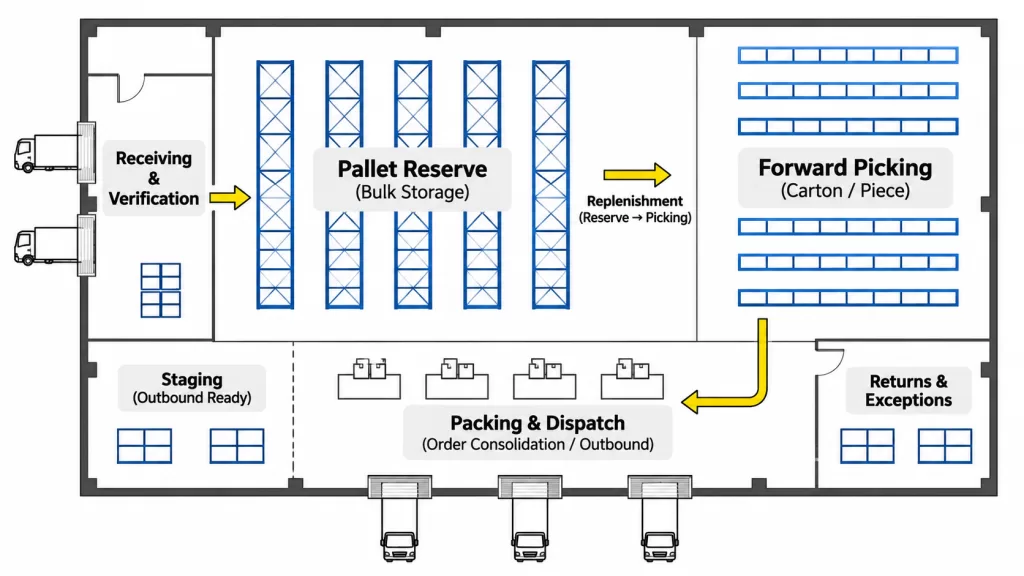
The Malaysian Ministry of Transport’s Guidebook to Starting Warehousing Business in Malaysia identifies storage, movement aisles, receiving/shipping, staging and other supporting areas as separate warehouse planning elements. A practical distribution centre can translate those functions into six connected zones:
- Receiving and verification: unload goods, check quantities and isolate discrepancies before put-away.
- Reserve pallet storage: hold backup stock, bulk cases and full pallets that replenish active picking positions.
- Forward pick faces: provide accessible carton or unit-picking locations for frequently ordered SKUs.
- Replenishment routes: connect reserve positions to pick faces without routinely obstructing outbound picks.
- Packing and dispatch staging: consolidate orders, label loads and hold goods awaiting carrier collection.
- Returns and exceptions: segregate damaged goods, customer returns and items awaiting identification or quality decisions.
The operating sequence is commonly Receiving → Verification → Reserve / Forward Picking → Packing → Dispatch, with replenishment feeding the pick zone and returns handled separately. The actual route depends on the site, dock arrangement and operating model. Staging and safe traffic routes must not be converted into ad hoc rack positions merely to increase quoted capacity.
Which Racking System Fits Each Zone?
A hybrid arrangement often makes more operational sense than putting the same rack system everywhere. Use storage density where it supports stockholding, and preserve direct access where staff frequently pick individual SKUs. The options below are screening choices, not a substitute for project-specific engineering.
| Operational zone | Racking option | Potential benefit | Condition to verify |
|---|---|---|---|
| Fast-access pallet reserve | Selective pallet racking | Direct access to individual pallets and comparatively simple SKU changes. | More aisle space than deeper-lane arrangements. |
| Bulk reserve with repeat SKUs | Double-deep or drive-in racking | Potentially fewer access aisles where inventory profiles permit. | Reduced selectivity; confirm truck reach, stock rotation and loading rules. |
| Carton / mixed-SKU pick face | Longspan or suitable medium-duty shelving | Dedicated locations for hand-picked cartons or parts. | Confirm safe shelf ratings, carton sizes, ergonomics and replenishment route. |
| Sequenced pallet movements | Gravity live-flow pallet racking, if specified for the load | Can support controlled flow in an engineered pallet-handling application. | Confirm pallet compatibility, FIFO flow, brakes/rollers and maintenance needs. |
| Vertical operating space | Mezzanine platform, where building and approvals permit | Potential additional storage or work area without horizontal expansion. | Requires professional review of structural load, access, fire strategy and operations. |
MR Space lists heavy-duty racking systems, medium-duty storage systems, 6000 Series Gravity Live Flow Racking and an 8000 Series Mezzanine Platform among its products. This range enables buyers to discuss different storage approaches with one supplier, while suitability and final engineering must still be assessed for each project.
For a detailed explanation of the capacity-versus-access trade-off, see the related MR Space article on how additional pallet racking can affect picking speed. This guide instead concentrates on choosing and sizing the distribution centre’s operating zones.
A Practical SKU-Slotting Example for a Malaysian 3PL Facility
Consider a hypothetical Malaysian distribution centre serving several retail customers. It handles 600 active SKUs and processes 300 outbound order lines per day. After examining its example order history, the operations team divides the stock into three groups.
The figures below are deliberately simplified teaching assumptions. They are not MR Space project results and are not intended to represent a universal 80/20 rule.
| SKU group | SKUs | Order lines/day | Share of lines | Indicative slotting decision |
|---|---|---|---|---|
| A: fast-moving | 60 | 180 | 60% | Directly accessible, conveniently placed forward pick faces; dependable reserve replenishment. |
| B: medium-moving | 180 | 90 | 30% | Standard access locations with proportionate pick-face space. |
| C: slow-moving | 360 | 30 | 10% | More remote or dense reserve positions where stock compatibility allows. |
| Total | 600 | 300 | 100% | Illustrative operating profile only. |
Only 10% of the SKUs generate 60% of order lines in this specific example. The practical response is not to allocate 60% of all warehouse floor area to Group A. Instead, it is to protect convenient pick locations for high-frequency activity while sizing reserve storage separately.
Demand velocity is only one factor. Consider weight, dimensions, item compatibility, pick ergonomics, customer segregation, expiry rules and products commonly ordered together. For a 3PL warehouse, customer inventory ownership and location traceability may also determine whether stock can be co-located. Those rules belong in operating procedures and the chosen inventory system, not in a rack label alone.
How to Size a Forward Pick Face Before Choosing Shelving
Forward pick faces hold the quantity that pickers are expected to access between replenishments. Too little space creates frequent emergency refills. Too much space occupies the most convenient positions with stock that could remain in reserve.
Take an illustrative carton SKU with these planning inputs:
- Average demand: 40 cartons per day.
- Peak-day demand: 54 cartons per day.
- Usable forward-location capacity: 60 cartons, assumed only after confirming shelf load and physical fit.
- Planned replenishment: once per working day.
The initial screening calculation is pick-face coverage (days) = usable cartons in the location / daily cartons picked.
| Scenario | Calculation | Result | Operational meaning |
|---|---|---|---|
| Average demand | 60 / 40 | 1.50 days | Some operating buffer if daily replenishment occurs on schedule. |
| Peak-day demand | 60 / 54 | 1.11 days | Just 6 cartons remain after one peak day. |
| Two-day peak without refill | 60 - (54 x 2) | -48 cartons | A deficit arises; the location cannot support the assumed service interval. |
This example does not imply that the shelf can safely store 60 cartons simply because there is space. Carton weight, safe load per level, shelf support, product stability and manual-handling practices must be checked first. It also assumes one SKU at one pick location, and ignores partial-case complications.
If the same location repeatedly empties before planned replenishment, options include increasing verified usable pick-face space, scheduling more frequent replenishment or changing when the SKU is refilled. The correct answer depends on demand variability and how much pick-face capacity other SKUs need.
This is where longspan shelving racks may be relevant for cartons, while selective pallet racking can support reserve pallets. Product configuration and any conversion between pallet and carton handling must be reviewed with the supplier.
Prevent Replenishment Traffic From Blocking Order Picking
Even a well-sized pick face can fail operationally when the reserve truck arrives in the middle of a busy picking wave. Plan how a replenishment pallet approaches the pick location, where the truck turns and whether a pedestrian picker is exposed to a vehicle crossing.
The UK Health and Safety Executive’s warehousing guidance highlights separation of pedestrian and vehicle routes, and the US OSHA warehousing guidance discusses rack protection, aisle clearances and safe materials handling. These provide useful risk-control examples, not replacements for Malaysian law or a local site risk assessment. Malaysian operators should also consult applicable local safety requirements, including the Department of Occupational Safety and Health’s guidance on employer responsibilities.
At layout review, ask whether:
- Receiving put-away and outbound pickers need to use the same narrow aisle at peak times.
- Cross-aisles, turning areas and emergency routes are visible and protected.
- Pallets waiting for dispatch block the route to replenishment stock.
- Guards, anchors, beam locks, loading notices and damage-response procedures are specified for the final configuration.
- Truck clearances come from the actual model and attachment combination, rather than a generic aisle-width assumption.
MR Space also lists an inspection service for installed rack structures. Engineering, anchoring and post-installation maintenance are discussed more deeply in its racking system engineering guide.
How Do 3PL, E-Commerce and Food Distribution Needs Differ?
Not every distribution centre should have the same layout. Match racking to fulfilment behaviour rather than the industry name alone.
| Operation | Typical planning challenge | Racking / layout consideration |
|---|---|---|
| 3PL / multi-client | Changing SKUs, customer ownership, variable contracts | Accessible, clearly identified storage locations; flexible partitioning and stock traceability. |
| E-commerce / parcel fulfilment | Many order lines, smaller pick quantities, daily peaks | Enough forward pick faces, packing interfaces and reliable replenishment paths. |
| FMCG / food distribution | High throughput; batch/expiry rotation may be important | Validate FIFO/FEFO processes and load-handling rules; verify temperature and hygiene requirements separately. |
| Full-pallet wholesale | Fewer pick events per SKU, higher pallet movements | Prioritise pallet access, safe loading, dock capacity and appropriate reserve density. |
For example, a 3PL site that changes clients every quarter may value a layout that can be revised without replacing entire rack systems. A food distributor must instead establish its stock-rotation controls and product-specific storage conditions before treating any dense racking arrangement as suitable. Specialist regulatory and operating requirements require separate verification.
If the company has large quantities of relatively homogeneous reserve pallets, drive-in racking may deserve evaluation. But for many active SKUs that need immediate individual access, selective racking is often the better starting point. A direct contrast between selectivity and density is also available in MR Space’s high-density storage operations guide.
What Should the Racking Supplier Receive Before Preparing a Layout?
A useful request for quotation is more than a request for a certain number of pallet bays. It should allow a competent design team to assess storage capacity, traffic, rack loads and the overall operating envelope.
- Building drawing: internal dimensions, columns, doors, clear heights, floor/slab conditions, obstructions, fire routes and sprinkler constraints.
- Load information: pallet footprint, loaded height, maximum pallet mass, unusual shapes or overhanging goods.
- Stock and orders: active SKUs, typical and peak pallet/carton demand, customer segregation and inventory rotation rules.
- Handling equipment: forklift/reach-truck models, lift height, turning/aisle requirements and attachments.
- Workflow: receiving, staging, reserve, picking, packing, returns and despatch volumes by shift.
- Handover expectations: verified design drawings, load signs, installation inspection, training and future inspection responsibilities.
Request at least one layout that protects pick access and one alternative that emphasises reserve capacity. Compare their constraints, not just bay counts. The supplier can propose appropriate heavy-duty pallet racking and medium-duty shelving configurations, but the warehouse operator must validate actual order flow, staffing and process assumptions.
How to Judge Whether the New Layout Is Working
After installation, use a small operational pilot to check whether the assumed traffic patterns and replenishment intervals match actual work. Do not judge the project solely by the number of storage positions created.
Useful measures include:
- Order lines picked per labour hour: outbound lines completed divided by the corresponding direct picking hours, with a consistent scope.
- Unplanned pick-face replenishments: urgent refills required outside the scheduled process.
- Travel and waiting: distance or time spent reaching locations and waiting for shared aisles.
- Dock and staging delays: pallets waiting in receiving or dispatch areas beyond their expected processing window.
- Safety and damage: reported rack impacts, blocked aisles and corrective actions.
- Inventory exceptions: location errors, misplaced stock and incomplete transfers.
Make changes only after checking both the benefits and the costs. Moving a high-frequency SKU nearer packing may reduce pick travel but increase congestion if it creates too many replenishments in one aisle. For a specialist discussion of picking-speed trade-offs, see MR Space’s pallet racking and picking speed analysis.
Conclusion: Design the Movement First, Then Select the Racks
Distribution centre racking in Malaysia works best when the physical storage plan reflects daily order flow. Map receiving and dispatch, distinguish pallet reserve from forward picking, classify SKUs by actual demand, and verify how replenishment will reach the busiest locations without obstructing workers or equipment.
A combination of selective pallet racks, denser reserve solutions and suitable carton shelving may be more practical than a single rack type across the building. The final configuration must still satisfy verified loads, equipment clearances, applicable approvals and a site-specific safety review. MR Space’s original storage racks Malaysia guide explains rack categories, while this new guide provides a distribution-centre planning framework for the next stage of the decision.
Frequently Asked Questions
Does a distribution centre need both pallet racking and shelving?
<p>Not always. It depends on whether orders are picked by full pallet, carton or individual piece. Mixed fulfilment operations may use pallet reserve with separate shelving-based pick faces, but the final mix should reflect order data and safe load requirements.</p>
What information should a 3PL warehouse collect before choosing racks?
<p>Collect active SKU counts, order-line volume, client ownership rules, pallet dimensions and weights, peak throughput, truck specifications, dock activity and a dimensioned building plan. Include future client-change requirements if flexibility is important.</p>
Can drive-in racking be used for a warehouse with many SKUs?
<p>It can be used for selected bulk or reserve stock, but it is often less suitable as the main access system when many individual SKUs must be retrieved frequently. Confirm lane allocation, stock rotation and truck operation before choosing it.</p>
How should a warehouse decide the size of a carton pick face?
<p>Estimate expected carton demand between replenishments, allow for peak variation and verify physical fit, load rating and ergonomics. Then pilot the replenishment frequency. The required capacity depends on the operation, not on a universal number of days.</p>
Is more pallet capacity always better for a fulfilment centre?
<p>No. Additional pallet positions may reduce space for packing, staging or cross-aisles. Compare usable storage capacity with actual order throughput, picker travel, replenishment work and safety constraints.</p>
Does buying racking automatically provide inventory tracking software?
<p>No. Racking is physical storage infrastructure. Location data, order allocation and replenishment scheduling require defined operating processes and, where appropriate, inventory or warehouse management software. Confirm any integrations separately.</p>
What should be checked before changing a distribution centre layout?
<p>Review current rack ratings and engineering drawings, floor conditions, forklift clearances, traffic separation, fire and emergency access, loading signs and damage inspection procedures. Obtain appropriate technical approval before moving frames or changing rated configurations.</p>
Plan a Distribution Centre Racking Layout With MR Space
If you operate a Malaysian distribution centre, 3PL warehouse or order-fulfilment site, start the enquiry with your floor plan, SKU and order profile, load specifications and forklift details. Explain where picking congestion, replenishment delays or insufficient storage currently affect operations.
MR Space supplies racking and shelving solutions that can be evaluated for the relevant zones, including selective pallet racking, dense storage options and medium-duty shelving. The correct configuration and installed capacity require a project-specific technical review.
Explore the heavy-duty racking product range or contact MR Space to discuss a warehouse racking layout.


