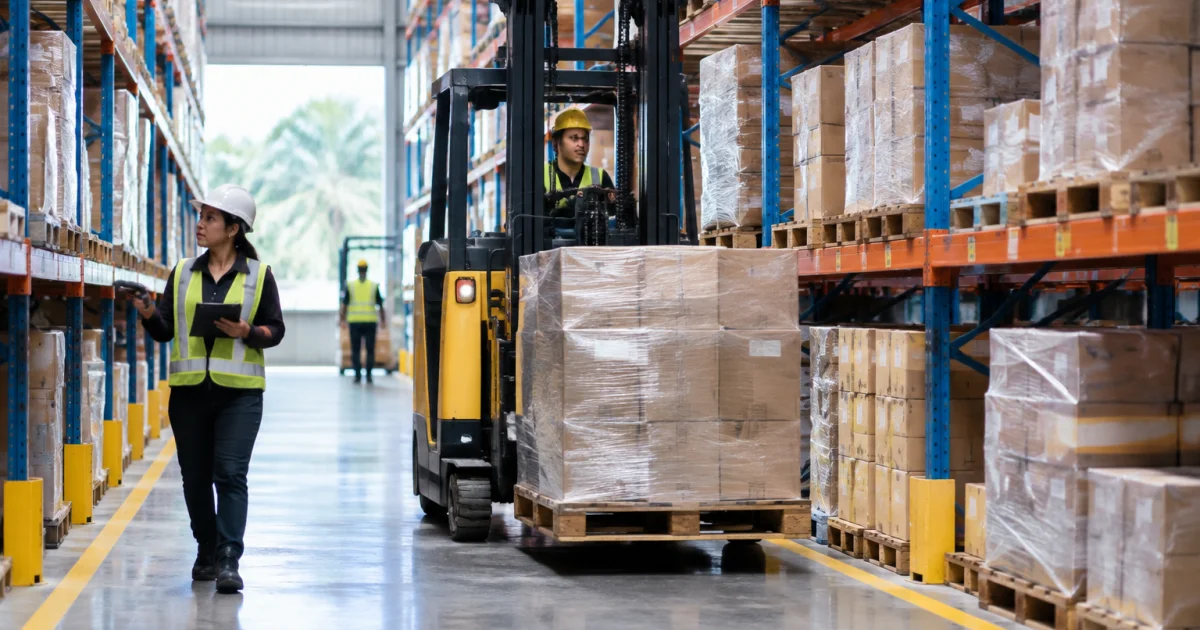
Warehouse conversations often start with a single number: “How many pallets can we store?” Capacity matters, but it’s not the same thing as throughput. In many Malaysian warehouses, the fastest way to miss your daily dispatch cut-off is to squeeze in more pallet positions until forklifts queue, pickers detour, and replenishment fights with outbound movements.
This article takes a clear position: “more pallets” isn’t automatically better for picking speed. In fact, over-optimising for storage density can introduce hidden time costs—extra travel, more touches, more waiting, and more exceptions. The good news is that you can often keep (or even increase) usable capacity and improve pick rate by designing a racking layout around your actual flow: receiving to put-away, replenishment to pick faces, picking to consolidation, and staging to loading.
Because you’re likely evaluating a Pallet Racking System Malaysia project (new build or retrofit), we’ll focus on the trade-offs that matter to warehouse managers and logistics engineers: aisle strategy, slotting logic, SKU velocity, replenishment design, and the “who moves where” reality of your material handling equipment.
Picking speed is a system outcome, not a storage outcome
Picking speed (lines per hour, cases per hour, or pallets per hour) is the output of an entire system: people, MHE, layout, slotting, and operating rules. Racking is a major part of that system, but it is not the only variable. When a project is defined as “we need 20% more pallet positions,” the design can unintentionally optimise the wrong objective.
From an engineering perspective, picking time is usually dominated by a few repeatable elements:
- Travel time: distance and path complexity from start point to pick locations and to drop points.
- Search and access time: locating the correct bay/level and positioning MHE safely.
- Handling time: lifting, removing, scanning/confirming, and placing on a pallet/cage/tote.
- Waiting time: congestion in aisles, blocked pick faces, and delays due to replenishment or put-away.
- Exception time: short picks, damaged pallets, mixed pallets, incorrect labels, or out-of-slot stock.
Increasing pallet capacity can make any of these worse if it narrows aisle options, pushes fast movers deeper into the building, or increases double-handling. So the correct question is not “How many pallets can we store?” but “How many customer orders can we pick and ship per hour with predictable labour?”
Why “more pallet locations” often slows picking: the four common mechanisms
When capacity-first racking designs underperform, it’s usually because of one (or more) of these mechanisms. They’re easy to overlook during early planning because they don’t show up on a simple pallet-position count.
1) Longer travel and fewer route choices
High-density layouts often reduce cross-aisles or create longer uninterrupted rack runs. That can increase average travel distance and force pickers to “go around” traffic. If your pick path becomes a single main artery, you’ve built a warehouse that behaves like a one-lane road.
2) Congestion between functions (put-away vs replenishment vs picking)
In real operations, the same aisles are used for multiple tasks. If you increase pallet storage in the same footprint without separating flows, you raise the chance that:
- Inbound put-away blocks pickers.
- Replenishment blocks outbound picking.
- Forklifts and reach trucks queue at the same “hot” locations.
Congestion is especially painful because it’s nonlinear: a small increase in traffic can create a large increase in waiting time.
3) More re-handling and more “touches”
Some density approaches increase the number of times a pallet is moved before it becomes pickable. For example, if pallets are stored deeper in lanes or behind other pallets, you may need to shift stock to access the target. Each extra touch consumes equipment time and increases damage risk.
4) More variability and exceptions
Dense storage tends to be less forgiving. Mixed pallets, odd dimensions, and partial pallets create slotting exceptions. If your “perfect” racking plan assumes uniform pallets and consistent labels, daily reality will erode pick speed through workarounds.
Practical example: two warehouses with the same pallet count, different throughput
Consider two simplified warehouses storing the same number of pallets.
- Warehouse A (capacity-first): tight aisles, fewer cross-aisles, long rack runs, fast movers scattered because the plan prioritised filling every available space.
- Warehouse B (flow-first): slightly fewer deep-storage zones near dispatch, more cross-aisles, dedicated replenishment windows/lanes, fast movers concentrated in easy-access pick areas.
On paper, Warehouse A looks “better” because it hits the capacity target with minimal footprint. In practice, Warehouse B often ships more orders with the same headcount because travel is lower, congestion is lower, and replenishment doesn’t collide with picking as often.
The takeaway is not that density is bad. It’s that density must be placed strategically. Put density where it won’t disrupt flow—typically for slow movers or reserve stock—while protecting fast-moving pick areas.
Racking choices and their picking-speed consequences
Not all racking types behave the same way under picking pressure. Below is a practical lens on common industrial racking systems and what they tend to do to throughput.
Selective pallet racking (single-deep)
Best for: high SKU variety, frequent access, easier cycle counting, lower exception rates.
Picking-speed impact: usually positive because access is direct (one pallet deep) and location logic is simple. The trade-off is lower storage density compared with lane-based systems. If your operation is order-driven with many SKUs, selective is often the safest baseline.
Drive-in / drive-through racking
Best for: high-volume, low-SKU count, LIFO/FIFO variants depending on configuration.
Picking-speed impact: can be neutral to negative for mixed-SKU picking. It can be efficient for full-pallet movements, but for pick-to-order environments it may introduce access delays and additional handling, especially when the “right” pallet is not at the front.
Push-back pallet racking
Best for: higher density with better selectivity than drive-in; useful when you want fewer aisles but still reasonable access.
Picking-speed impact: can be excellent for reserve storage feeding a separate pick face, but it’s not automatically ideal as the primary pick zone for many SKUs. You gain density, but you must manage lane assignment and replenishment discipline to prevent hunting and exceptions.
If you want to explore this approach, see the product reference for push-back pallet racking systems and evaluate whether it fits reserve stock rather than your main pick path.
Gravity flow (pallet flow) systems
Best for: high-throughput FIFO lanes, consistent pallet quality, structured replenishment.
Picking-speed impact: often positive for FIFO replenishment and predictable access at the pick face. However, the system needs disciplined lane sizing, strong pallet condition control, and robust safety practices.
The “fast movers problem”: when higher density pushes your velocity SKUs too far away
The biggest picking-speed killer is usually not the racking type—it’s where fast movers end up. When you add more pallet positions, you may unintentionally:
- Place A-items deeper into the warehouse because prime zones are consumed by reserve stock.
- Scatter high-velocity SKUs across multiple aisles, increasing zig-zag travel.
- Create frequent “hot spots” where many orders require the same bay area, causing queues.
A flow-first design protects a compact, highly accessible pick zone for A-items, with clear replenishment paths that do not interfere with picking. This is where many Warehouse Racking System Malaysia projects go wrong: the storage plan looks efficient, but the operational plan for velocity SKUs is missing.
Actionable slotting rules that improve speed without changing your headcount
- Consolidate A-items into fewer aisles close to dispatch/consolidation.
- Reduce “split locations” for the same SKU unless you have a clear overflow policy.
- Separate pick faces from reserve where possible (even if it’s just a dedicated section within selective racking).
- Design replenishment timing: schedule or batch replenishment to avoid peak pick windows.
These are operational rules, but they only work if the racking layout supports them with sensible access and travel paths.
Aisle strategy: the hidden throughput lever most layouts ignore
When people talk about fitting more pallets, they often focus on making aisles narrower. Narrow aisles can increase storage density, but they can also reduce throughput if they constrain movement or require a different equipment strategy.
Narrower aisles are not “free capacity”
In practice, narrower aisles can create:
- Lower passing ability: one slow manoeuvre blocks everyone behind.
- More reversing and repositioning: especially at high levels or with longer pallets.
- Higher interaction risk: tighter tolerances raise the cost of minor errors.
That doesn’t mean narrow aisles are wrong—only that they must match your MHE, your skill levels, and your peak traffic pattern. If your operation relies on simultaneous picking, replenishment, and put-away, you may need a layout that provides alternative routes and staging buffers rather than a single constrained corridor.
Cross-aisles, end-aisles, and “escape routes”
Cross-aisles are often sacrificed for capacity. But cross-aisles can dramatically reduce average travel distance and relieve congestion by creating more route choices. Think of them as “escape routes” for forklifts and order pickers.
If you’re redesigning a racking system, ask a blunt question: Where do vehicles wait when they can’t proceed? If the honest answer is “in the pick aisle,” you’ve built waiting time into every shift.
Reserve vs pick: stop forcing one storage method to do two jobs
A common mistake is trying to make a single racking configuration serve both reserve storage and high-frequency picking. The needs conflict:
- Reserve storage prioritises density and safe, stable storage of full pallets.
- Pick storage prioritises easy access, simple location logic, and minimal travel.
When you chase maximum pallet capacity, you often turn pick areas into reserve areas—then wonder why picking is slow.
A practical hybrid pattern that works in many Malaysian DCs
- Selective racking (or a dedicated selective zone) for pick-accessible pallets and high-mix items.
- Higher-density racking (push-back, drive-in, or flow depending on SKU behaviour) for reserve pallets feeding the pick zone.
- Clear replenishment lanes/staging so reserve-to-pick movements don’t block pickers.
In other words: use density where it belongs. Don’t let density invade the path of fastest-moving work.
When a mezzanine floor is the better “capacity” move than denser pallet racking
Sometimes the right answer to “we need more space” is not to compress pallet storage at all. If your picking includes cartons, parts, or mixed-case work, a mezzanine floor can add productive space above the ground operations—without turning aisles into bottlenecks.
For example, you can:
- Keep ground level for pallet in/out and forklift traffic.
- Move slow, small-item storage, packing, kitting, or documentation upstairs.
- Create dedicated areas for returns, QA hold, or value-added services.
This reduces cross-traffic on the pallet floor and can improve picking speed because outbound processes are less disrupted. If you’re considering vertical expansion, the engineering and safety requirements matter; a supplier with design-to-install capability can help align structural design with workflow. For a related local example, you can read about custom mezzanine floor solutions and how teams typically plan around access, stair placement, and operating zones.
Safety and compliance: speed disappears when the system feels risky
Here’s an operational truth: when operators don’t trust a system, they slow down. If the rack looks overloaded, beams are damaged, or load signage is unclear, people naturally reduce speed—or they take unsafe shortcuts, which eventually forces shutdowns and repairs.
A picking-speed discussion must include racking integrity and load clarity, especially for heavy duty applications. If your site is upgrading to a heavy duty racking system, ensure load ratings are clearly specified and maintained through inspections and training. A helpful companion read is Warehouse Racking System Malaysia compliance, load ratings, and safety, which outlines the practical thinking behind safe load management.
This article is an opinion about throughput, but the fact is simple: safe operations are faster over time because they reduce incidents, damage, and unplanned downtime.
How to decide: a picking-speed checklist for your next racking redesign
If you’re evaluating Racking Malaysia suppliers or preparing an internal business case, use this checklist to keep the project anchored to throughput instead of just pallet count.
1) Map your “day in the life” flows
- What are the peak hours for receiving, picking, replenishment, and loading?
- Where do inbound pallets stage before put-away?
- Where do picked pallets/cartons consolidate before dispatch?
If multiple functions share the same narrow corridors at the same time, you have a congestion problem waiting to happen.
2) Classify inventory by velocity and handling unit
- Which SKUs move daily (A), weekly (B), monthly (C)?
- Which are full-pallet picks vs case picks vs piece picks?
- Which SKUs create exceptions (odd sizes, fragile packs, mixed pallets)?
Then design zones, not just racks.
3) Separate access needs from density needs
Ask: “What must be immediately accessible during peak picking?” That stock belongs in selective or in a dedicated pick face. Reserve stock can be denser—so long as replenishment is predictable.
4) Validate the travel model, even if it’s simple
You don’t need a complex simulation to catch big mistakes. Rough-calculate average travel to the top 20 SKUs and compare two layouts. If the “denser” layout adds several extra turns, longer aisle runs, or longer distance to dispatch, it will likely reduce pick rate unless labour or equipment also changes.
5) Stress-test the layout with “bad days”
Run scenarios:
- A truck arrives late and inbound pallets must stage longer.
- One aisle is temporarily blocked for maintenance.
- Fast mover demand spikes and replenishment frequency doubles.
A layout that only works on perfect days is not a high-throughput design.
6) Confirm your maintenance and change plan
Racking is not a one-time decision. Your SKU mix, order profile, and packaging will change. Choose a system that can be adjusted (beam levels, bay configurations, add-on sections) without a major rebuild.
If you want a broader starting point on how businesses choose systems, you may find Choosing the right warehouse racking system for your business needs useful as a pre-read before engaging your internal stakeholders.
Conclusion: optimise for shipped orders, not stored pallets
It’s tempting to treat pallet positions as the scoreboard, especially when warehouse space is tight. But if your goal is faster picking and smoother dispatch, storage density is only valuable when it supports flow.
My view is straightforward: the best pallet racking decision is the one that reduces travel, prevents congestion, and makes replenishment predictable—even if it means you accept slightly fewer pallet positions in the prime area. Use high density where it won’t disrupt picking, protect a compact fast-mover zone, and design aisles and cross-aisles for the traffic you actually have (not the traffic you wish you had).
If you approach your next racking project this way, you’ll be measuring success in the metric that matters most: how quickly and consistently your warehouse can ship.
Frequently Asked Questions
Does increasing pallet storage capacity always reduce picking speed?
Not always, but it often can if the added capacity increases travel distance, reduces route options, or creates congestion between picking and replenishment. The impact depends on SKU velocity, order profile (full pallet vs case), aisle strategy, and how well reserve stock is separated from pick-accessible locations.
Which racking type is usually best for fast picking in a high-SKU warehouse?
For high SKU variety with frequent access, selective pallet racking is typically the safest choice because it provides direct access to each pallet location and simpler location control. Higher-density options (like drive-in or push-back) can still be useful, but they often perform best as reserve storage feeding a dedicated pick zone rather than as the primary pick area.
How do I reduce aisle congestion without expanding my warehouse footprint?
Start by separating flows: define clear staging areas, protect pick aisles from inbound put-away during peak picking, and design replenishment routes that avoid hot pick zones. If you’re redesigning racking, consider adding cross-aisles or alternative routes, even if it slightly reduces pallet count—because it can reduce waiting time and improve throughput.
When should a mezzanine floor be considered instead of denser pallet racking?
A mezzanine floor is worth considering when your bottleneck is mixed-case work, packing, kitting, archives, or small-item storage that competes with forklift traffic on the ground. By relocating non-pallet activities upstairs, you can keep pallet operations clearer and often improve picking and dispatch flow without compressing aisles.
What information should I prepare before requesting a racking layout proposal in Malaysia?
Prepare your pallet and carton dimensions, maximum pallet weights, SKU velocity (A/B/C), order profile (full pallet vs case/piece), daily inbound/outbound volumes by time window, MHE types used (forklift/reach truck/order picker), available floor plan and clear height, and any special constraints (fire lanes, columns, dock positions, staging needs). This helps a supplier propose a racking system that supports both capacity and picking speed.
Plan a racking layout that improves picking speed—not just pallet count
If you’re rethinking warehouse storage in Malaysia, Mr Space can help you design a racking layout around real workflows: fast-mover access, replenishment paths, aisle strategy, and safe load performance. With in-house design, local manufacturing, installation, and maintenance support, we’ll help you balance capacity with throughput using the right mix of pallet racking, heavy duty systems, and space solutions such as mezzanine floors.


