Procurement comparisons often start with a simple number: cheaper per bay. It feels objective, it fits nicely into a spreadsheet, and it gives stakeholders a fast “winner.” But for a Warehouse Racking System Malaysia project, that metric can be dangerously incomplete.
Racking is not just steel. It’s a structural system that shapes forklift traffic, picking routes, replenishment speed, safety risk, maintenance workload, and how quickly you can recover from a bump, a product change, or a layout revision. In my view, “cheaper per bay” is one of the most common ways companies accidentally buy downtime.
This article is an opinionated guide for warehouse managers, operations leads, facility engineers, and procurement teams. I’ll separate opinion from what is generally true in the field, and give you a practical checklist to evaluate the total cost of ownership (TCO) when comparing quotes.
The hidden problem with “per bay” comparisons
Fact: A “bay” is not a universal unit. Depending on the design, one bay can have different frame depths, beam lengths, beam levels, load capacities, accessories, and even different assumptions about pallet type and forklift handling. Two suppliers can quote “10 bays,” and you may still be comparing two different systems.
Opinion: When your internal discussion centers on per-bay price, you’re incentivizing suppliers to reduce what’s less visible at quoting stage: stiffness, protection, finish quality, tolerances, and on-site fit and installation discipline. Those are precisely the items that reduce damage and keep aisles running smoothly.
Here are common “per-bay” blind spots that later become operational costs:
- Capacity assumptions: Beam ratings and frame capacities may be presented differently (per pair of beams, per level, per bay, uniformly distributed vs point loads).
- Number of beam levels: Extra levels change price and performance; missing levels shift storage strategy and picking behavior.
- Accessories excluded: Column guards, end-of-aisle barriers, row spacers, pallet supports, back-to-back ties, and mesh decks may be treated as optional.
- Layout compromises: A cheaper bay count can come from a layout that creates tighter turning, more shunting, or lower selectivity.
- Installation scope: Anchoring method, floor condition checks, and compliance documentation may be thin or ambiguous.
If you only compare per-bay numbers, you might be selecting the quote with the highest future disruption.
Where the “cheap” system starts charging you: downtime, damage, and rework
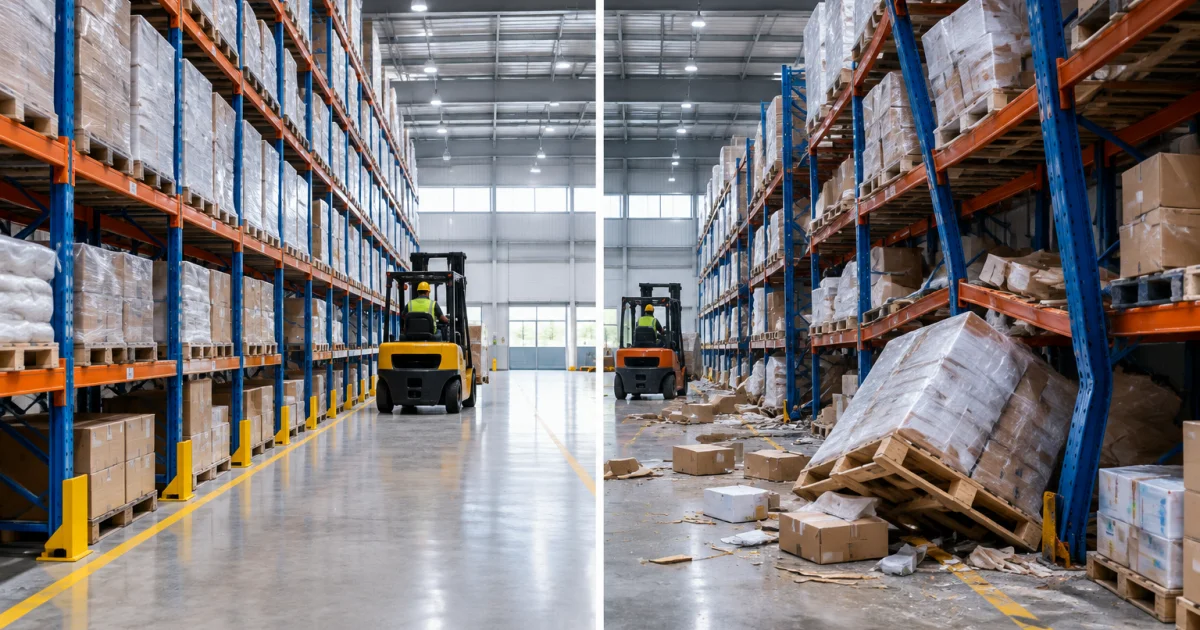
Fact: Most warehouses don’t lose money because racking “fails.” They lose money because small problems compound: a bent upright that narrows an aisle, beams that don’t sit square after minor impact, pallets that don’t land cleanly, or an aisle closed for repair during peak receiving.
Opinion: The best way to understand TCO is to imagine your warehouse on a stressful day: late inbound arrivals, urgent orders, new SKUs, new forklift drivers, and high traffic. The system that holds alignment and tolerances under stress is usually the system that’s cheaper over time—even if it wasn’t the lowest quote.
Downtime you don’t budget for
- Aisle closures: Damage assessment and repair work often require isolating a bay or aisle for safety.
- Slow handling: Poorly designed aisles and inadequate clearances reduce forklift cycle time and increase “micro-delays.”
- Re-slotting and rework: If the system can’t adapt to changes (pallet types, carton flow, new replenishment patterns), you pay in labor hours.
Damage that spreads
Racking damage rarely stays local. A bent upright can affect beam seating; a misaligned row can lead to more pallet rub and more impacts; a missing protection detail at aisle ends can become a recurring repair job. That’s why protection accessories (and the right ones in the right places) are not “nice-to-have.” They’re a strategy to keep operations stable.
Rework that looks like “improvement projects”
When racking doesn’t match workflow, teams often work around it: adding temporary storage, changing pick paths, shifting staging areas, or installing ad-hoc barriers. These workarounds are operational rework. They consume space and attention, and they usually appear months after go-live—long after the “per bay” victory lap.
A practical way to compare racking quotes: evaluate the system, not the steel
If you want an apples-to-apples comparison, you need a shared evaluation frame. Below is a practical approach you can use in Malaysia whether you’re building a new warehouse, upgrading an existing facility, or replacing damaged racks.
1) Define the operating reality (before you talk about product)
Start with what drives impacts and inefficiency, not just how many pallets you want to store.
- Pallet profile: Standard pallet dimensions, overhang expectations, and load stability.
- Load characteristics: Uniform vs non-uniform loads, fragile goods, high center-of-gravity pallets.
- Handling equipment: Reach trucks vs counterbalance forklifts, turning radius, mast height, driver skill variation.
- Throughput: Receiving peaks, dispatch peaks, cross-dock needs, and staging requirements.
- SKU volatility: How often slotting changes; growth expectations for the next few years.
Opinion: When a supplier asks these questions early, it’s usually a sign they’re designing for uptime, not just quoting steel.
2) Compare load ratings and safety assumptions consistently
Fact: Load ratings can be misunderstood. You should ask each supplier to clarify exactly what their stated ratings refer to (beam pair, level, bay, frame) and the conditions assumed.
Practical checks you can request in writing:
- Clear statement of beam capacity per level and frame capacity under specified configurations.
- Defined upright profile, thickness, bracing arrangement, and how it relates to allowable loads.
- Recommendation for anchors based on your slab condition and expected impacts.
- Required clearances for safe pallet placement and forklift handling.
If you need a deeper refresher, you can reference Mr Space’s guide on compliance, load ratings, and safety considerations.
3) Treat protection and accessories as core scope, not add-ons
Many racking projects become expensive because protection was value-engineered away. In high-traffic environments, it’s often cheaper to prevent repeated minor damage than to repair it.
Accessories to review as part of the base solution:
- Upright/column guards at aisle ends and high-risk locations
- End-of-aisle barriers where turning impacts are common
- Row spacers / ties for back-to-back stability
- Pallet supports or decking where pallet quality varies
- Safety pins/locks and load signage provisions
Opinion: If two quotes differ significantly, look first at what’s missing from the “invisible” scope: protection, documentation, and installation quality controls.
4) Validate layout efficiency, not just storage density
Fact: Higher density is not always higher productivity. Systems like drive-in, push-back, and gravity flow can increase density, but they also change selectivity, replenishment patterns, and equipment needs.
Ask suppliers to show how their design affects:
- Travel distance for put-away and picking
- Aisle widths and turning behavior at intersections
- Staging zones for inbound/outbound peaks
- Expansion plan (can you add levels, extend rows, or convert zones later?)
When the goal is to reduce operational cost, consider reading how the right racking system can reduce operational costs and use it as an internal discussion tool.
Malaysia-specific buying realities: lead time, serviceability, and local manufacturing support
This is where commercial investigation gets real: after installation, you’re living with the system. When damage happens (and it will, at some point), the question is how quickly you can assess, source parts, and restore safe operation.
Opinion: In Malaysia, your best “insurance policy” is not just a low purchase price—it’s a supplier with engineering support, reliable parts availability, and a disciplined installation and maintenance capability. The ability to respond quickly can be the difference between a minor repair and a multi-aisle disruption.
Consider these vendor questions:
- Who manufactures the racking? A local Racks Manufacturer Malaysia with in-house processes can often control tolerances and finish consistency, and support repeat orders more predictably.
- Do they provide site measurement and layout planning? Mistakes here show up as misfits, rework, or compromised clearances.
- Do they install with trained crews? Correct anchoring, alignment, and beam engagement matter for long-term performance.
- What’s the maintenance pathway? Can they inspect, replace components, and advise on safe usage after impacts?
If you’re still early in your evaluation, Mr Space also has a quick primer on what a warehouse racking system is and how the main types differ in use.
Don’t ignore vertical space: mezzanine floors as an alternative to “more bays”
Fact: Some facilities hit a floor-space limit before a storage limit. When you can’t widen aisles or add rows without hurting flow, vertical solutions can be more economical than squeezing in more racks.
A mezzanine floor can create additional storage, packing, kitting, or light-production space above existing operations. It’s not a replacement for pallet racking, but it can change the equation: instead of chasing a cheaper bay price, you may be redesigning the warehouse storage strategy to reduce congestion and improve throughput.
Opinion: Teams that only optimize “per bay” often overlook mezzanine options because it doesn’t fit the same unit pricing model. But it may reduce the downstream cost of congestion—especially in facilities with strong growth pressure.
Conclusion: buy uptime, not bays
“Cheaper per bay” is a tempting shortcut, but it can hide the costs that matter most to operations: downtime, damage, and rework. If you want your next racking investment to stay economical after go-live, compare systems on operating reality—load assumptions, layout efficiency, protection scope, installation quality, and serviceability.
In practice, the best Racking System Malaysia decision is usually the one that keeps your aisles open, your handling smooth, and your team confident in safe daily use. That outcome rarely comes from the cheapest number in the first column of a spreadsheet.
Frequently Asked Questions
What should I compare besides “price per bay” when buying warehouse racking?
Compare load rating assumptions (per level/bay and under what conditions), aisle clearances for your forklifts, protection accessories (guards/barriers), installation scope (anchoring and alignment), and how easy it is to maintain or replace damaged components without shutting down aisles.
How do I know if a racking supplier’s load ratings are comparable to another quote?
Ask each supplier to state ratings in the same format (beam pair per level, frame capacity, and bay configuration) and to document the assumptions used (pallet size, load distribution, beam spacing, and the number of levels). If the formats differ, you’re not comparing like-for-like.
Is heavy duty racking always the best choice for Malaysian warehouses?
Not always. Heavy duty pallet racking makes sense for high-load, palletized storage with forklift handling, but some zones may be better served by medium-duty longspan, boltless shelving, or specialized systems like push-back or drive-in depending on selectivity and throughput needs. A mixed solution is common in warehouse storage Malaysia projects.
Do I really need column guards and end-of-aisle barriers?
If you have frequent forklift traffic, tight turning, mixed driver skill levels, or high picking intensity, protection is often cheaper than repeated repairs and aisle downtime. Guards and barriers reduce the chance that small impacts become structural issues that require isolation and rework.
Can a mezzanine floor be a better investment than adding more racking bays?
Yes, when floor space is constrained or adding more rows would create congestion. A mezzanine floor can add usable space for packing, kitting, light storage, or staging without expanding the building footprint, which may improve workflow and reduce bottlenecks.
Plan a racking layout that protects uptime—not just the budget
If you’re evaluating a new warehouse storage setup or replacing damaged racks, Mr Space can help you compare options based on workflow, safety, and total cost of ownership—not just “per bay” pricing. We provide in-house design, local manufacturing, supply, installation, and maintenance for pallet racking, heavy duty systems, mezzanine floors, and custom storage solutions across Malaysia.
Share your pallet details, forklift type, and throughput needs, and we’ll propose a layout and specification that’s built to reduce downtime, damage, and rework.


