
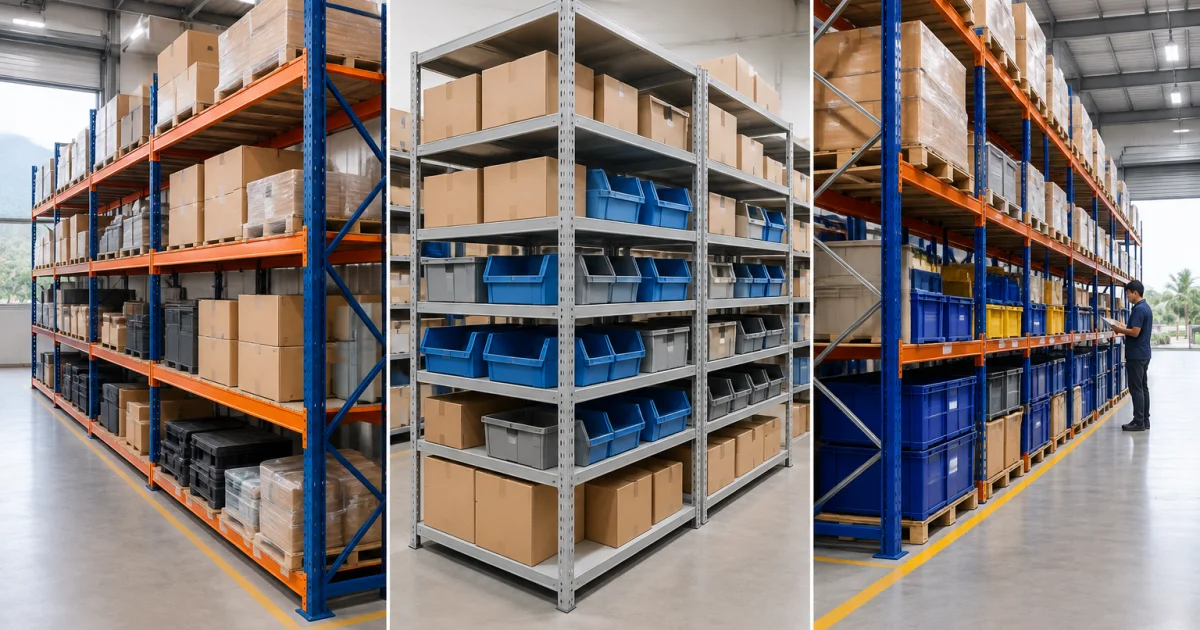
For Malaysian warehouses, longspan shelving is worth evaluating when cartons, mixed-size boxes and spare parts need accessible, wider shelf openings. Boltless shelving is worth evaluating when fast assembly and adjustable storage are important. However, neither name tells you the safe load capacity on its own. A heavy-duty boltless rack can carry more than some longspan configurations, while a longspan rack may be better suited to certain wide cartons. The correct choice depends on the approved configuration, not the label.
Choosing a shelving rack in Malaysia should therefore begin with a practical question: What will the rack hold, how will staff reach it, and what load will each level actually experience? This guide helps procurement, warehouse, maintenance and facility teams compare longspan and boltless systems without treating “industrial shelving” as a separate, automatically stronger category. It also explains what to verify before requesting a quotation from Mr Space.
Longspan vs Boltless Shelving: What Is the Actual Difference?
The most useful distinction is how the system is configured, rather than a blanket assumption that one type supports heavier stock.
| Term | What it describes | What buyers must not assume |
|---|---|---|
| Longspan shelving | A shelving arrangement designed to offer relatively wide access spans for appropriate loads and goods. | That every longspan model has the same width, loading or decking options. |
| Boltless shelving | A shelving system assembled using interlocking or similar connections without conventional nuts-and-bolts at the primary joints. | That all boltless racks are light-duty or suitable for the same application. |
| Industrial shelving | A broad application description for shelving selected and specified for industrial use. | That “industrial” is a third, mutually exclusive connection or design type. |
| Pallet racking | A separate storage-system category designed for specified pallet and mechanical-handling requirements. | That ordinary shelving can accept loaded pallets without specific engineering approval. |
In short: longspan concerns the shelf arrangement and available span; boltless concerns the connection method; industrial describes the operating environment. Their features can overlap. For specific configurations, start with Mr Space’s shelving rack product range rather than selecting a system solely from these categories.
Five Specifications to Check Before Choosing a Shelving Rack
1. What is the heaviest stock you actually store?
Start with real inventory, not a supplier’s headline capacity. Record the maximum weight of a carton, bin or component, its footprint, how many units share a shelf, and how frequently it is handled. Dense fasteners, bearings and motor components can impose much higher local loads than large but lightweight cartons.
Separate hand-picked stock from palletised reserve inventory. If the storage task depends on forklift placement of loaded pallets, investigate a suitable pallet-racking system rather than assuming general-purpose shelving will work.
2. Is the stated load rating per shelf, per bay or for the complete rack?
A shelf rating is meaningful only when its unit, load distribution and approved configuration are clear. A uniformly distributed load (UDL) describes weight spread across the intended shelf area under specified conditions. A compact motor or tooling block can concentrate load at a small contact area, even when its total weight appears modest.
For example, twelve cartons weighing 20 kg each represent 240 kg of goods. That arithmetic is only a starting point: you still need to know whether their weight is spread appropriately, whether the deck and supports are suitable, and whether the manufacturer has approved the complete installation. Never translate a published UDL figure into an allowable point load without confirmation.
Ask separately for the rated load per level, the rated load per bay/system, and the conditions attached to those figures. Do not assume a rating from one model or dimension applies to a taller or wider configuration.
3. How much clear shelf width and access space do you need?
Measure your largest SKU with its outer packaging, not just its nominal product size. A wide carton may fit within the overall rack footprint but still be awkward to retrieve if uprights obstruct the access opening. Check the usable clear width between members, shelf depth, picking height and safe removal space.
Longspan is often worth shortlisting where wide cartons and mixed-format parts benefit from less interrupted access. Nevertheless, the approved span and beam arrangement govern the allowable load. Increasing shelf width without rechecking the manufacturer’s configuration can change structural performance.
4. Which decking material suits the stockroom?
Plywood, fibreboard, galvanised shelving, steel panels and wire-mesh options offer different practical characteristics. The best choice depends on how stock rests on the surface, the likelihood of moisture exposure, cleaning needs and the specified loading arrangement.
In humid storerooms, inspect the suitability of the decking and finish rather than assuming every board or metal panel performs identically. Where items rest on small feet or narrow contact points, confirm how the deck transfers those loads to its supports. Any requirement involving fire behaviour, chemical exposure or food handling deserves separate product verification.
5. How will staff pick, replenish and move around the racks?
Capacity on paper can be misleading if a layout creates congestion. Record how many picks each area handles, where trolleys turn, how staff replenish shelves, and whether fast-moving bins are accessible at comfortable working heights.
For example, a maintenance store may benefit from adjustable bin locations and clear product labelling, while a dispatch-area shelving run may need larger picking openings and unobstructed aisles. Evaluate workflow before choosing bay numbers or shelf levels.
When Is Longspan Shelving the Better Option?
Longspan shelving is often a strong candidate for manually handled cartons, kitting materials, mixed parts and stock with relatively wide dimensions. It is particularly useful when buyers need different bay widths and decking arrangements within a planned storage system.
Mr Space offers the 2100 Series Longspan Shelving Rack (Plywood) and the 2000 Series Longspan Shelving Rack (Fibreboard). Their official product pages provide dimensional and decking information for initial planning. Confirm the exact proposed material, shelf spacing and approved load data before ordering; the product name or a headline figure should not replace a configuration-specific specification.
Example: An MRO store with cartons, filters and replacement parts
An MRO team stores filters, maintenance kits and boxed spares of different widths. The immediate problem is not maximising tonnes of inventory. It is reducing double-handling and making every labelled item accessible. A longspan configuration with appropriate clear openings and load-approved decking may be more useful than numerous narrow bays.
However, dense motor parts and tooling should not automatically share the same shelf assumptions as lightweight filters. Separate these load cases and assess them individually.
When Does Boltless Shelving Make More Sense?
Boltless shelving deserves consideration where modular assembly, adjustable shelf positions and frequent changes to stock organisation are priorities. Offices, service rooms, maintenance workshops and commercial stores may benefit from the format, provided the selected product is rated for the intended loads and environment.
The important correction is that boltless does not mean light-duty. Mr Space markets the 600 Series Heavy Duty Boltless Rack for demanding applications. This is why a buyer must compare specific models and their approved loading conditions rather than ranking boltless below longspan by default.
Explore the wider boltless racking range to identify possible configurations. The category includes products with different stated duties, so never infer that all entries share a common rating.
Example: A changing workshop parts store
A workshop reorganises consumables and service kits several times a year. It needs clearly labelled bins and shelf levels that can be adjusted when the SKU mix changes. A suitable boltless system may support that workflow, assuming the installed configuration is stable and the individual shelf and bay capacities are verified.
Where heavy parts, repeated impacts or greater heights are involved, move beyond assembly convenience and request the engineering information for the proposed rack.
Is Industrial Shelving a Third Alternative?
Not in the same sense. Industrial shelving describes an application and performance requirement, not one universal construction method. Depending on the selected design, an industrial storage installation may use longspan, boltless or another suitable shelving arrangement.
When the proposed storage area contains dense metal parts, taller bays or repeated mechanical handling nearby, the buyer should assess frame rigidity, deck suitability, anchoring where required, impact exposure and the manufacturer’s stated load configurations.
Mr Space’s 3800 Series Heavy Duty Shelving Rack provides an example of a separate heavy-duty product range worth evaluating for appropriate applications. It should not be presented as the only kind of “industrial shelving” or automatically compared with a boltless rack on capacity without matching configurations.
Mr Space Shelving Models: What Should Buyers Compare?
Use these examples to understand product families. This is not a ranking or an engineering approval of any model for a particular building.
| Mr Space range | Why review it | What to confirm in the quotation |
|---|---|---|
| 2000 Series Longspan (Fibreboard) | Compare decking and dimensional options for manually accessed stock. | Actual proposed decking, span and configuration-specific loads. |
| 2100 Series Longspan (Plywood) | Review a longspan option for cartons, bins and mixed parts. | Deck support, concentrated loads, level capacity and usable opening. |
| 600 Series Heavy Duty Boltless | Illustrates why boltless systems should not all be classified as light-duty. | Which published capacity applies to each approved model and load arrangement. |
| 3800 Series Heavy Duty Shelving | Evaluate an engineered, heavy-duty shelving option. | Load rating, stability, installation requirements and handling interface. |
The correct recommendation must reflect the specific bay dimensions, number of shelf levels, weight distribution, flooring and operating practices. If a product page uses a headline UDL figure, ask whether it applies per level or to a wider assembly and obtain written confirmation for the quoted system.
Three Practical Selection Scenarios in Malaysian Warehouses
Scenario 1: Fast-moving cartons crowd the packing area
A distribution team needs immediate access to varying carton sizes near dispatch. The most valuable specification may be usable pick-face width, an appropriate shelf depth and a layout that avoids blocking packing routes. Review a suitable longspan configuration first, then compare other options against the same carton and workflow requirements.
Scenario 2: Workshop SKUs and bin locations change frequently
A service department regularly changes its spare-parts inventory. Adjustable levels, clearly labelled compartments and straightforward reconfiguration are priorities. Consider boltless shelving, but verify the weight of loaded bins and the load limits after any proposed rearrangement.
Scenario 3: Dense tooling and heavy components dominate
A manufacturing store handles steel tooling, bearings and motor assemblies with concentrated weight. Start with structural and load-distribution requirements, not with whether the rack is branded longspan or boltless. A heavy-duty shelving configuration may be necessary; obtain the manufacturer’s approved data and clarify whether separate lifting or handling equipment is required.
These scenarios illustrate the decision process; they are not claimed project results or guaranteed performance improvements.
How to Compare Total Cost Without Choosing the Cheapest Rack
A shelving quotation can look attractive while omitting deck supports, anchors where required, protective components, delivery, layout preparation or installation. More importantly, an unsuitable configuration can increase damaged stock, replenishment time and maintenance work.
| Evaluation factor | Question for the supplier | Operational consequence |
|---|---|---|
| Approved loading | What is the rated load per level and per bay, and under which load pattern? | Reduces the risk of selecting an unsuitable system. |
| Usable access | Can the largest item be removed safely without double-handling? | Affects picking speed and aisle congestion. |
| Decking and finishes | Which surfaces are supplied and suited to the storage conditions? | Affects maintenance and stored-goods protection. |
| Installation scope | Are surveys, fixing, protection and load notices included where needed? | Prevents quotation and handover gaps. |
| Changes over time | What can be adjusted, and when must the design be rechecked? | Supports safer reconfiguration as SKUs change. |
For a more detailed purchasing process, see Mr Space’s questions to ask before accepting a racking quotation.
Installation and Inspection: What Should Buyers Verify?
Even a correctly selected shelving system can perform poorly if installed on an unsuitable floor, configured outside its rated limits or struck repeatedly by handling equipment.
Malaysia’s Department of Occupational Safety and Health guidelines for the courier-services industry discuss principles for safe racking installation, including sound floors, designer/manufacturer-defined loads, suitable aisle access and clear maximum-load information. Those guidelines address the sector and racking arrangements described in the document; they do not provide one universal numeric load rating for all types of shelving.
For further general warehouse safety principles, the UK’s Health and Safety Executive warehousing guide recommends suitable system design, inspection and controls against vehicle impacts. This is a useful reference, not a substitute for Malaysian requirements or the supplier’s approved design.
Before handover, confirm installation according to the manufacturer’s instructions; suitable floor conditions; appropriate fixing and impact protection where required; clear usable load information; and a process for reporting damaged members. Changes to shelf levels or beam positions may affect approved capacity. Ask the manufacturer or qualified designer to confirm the revised arrangement before making significant alterations.
Mr Space’s article on racking engineering, anchoring and maintenance provides further context for industrial storage planning.
What to Send Mr Space Before Requesting a Shelving Proposal
A useful enquiry should allow the supplier to assess the actual installation rather than guess from a photograph of an empty storeroom. Include:
- Storage item details: descriptions, packaging, the heaviest single item and quantities per shelf.
- Available dimensions: usable wall or floor space, desired shelf height, obstacles, doors and access routes.
- Handling method: manual picking, trolleys, nearby forklifts and replenishment frequency.
- Operating conditions: humidity, cleaning practices, floor condition, impact exposure and any special requirements.
- Future needs: expected SKU changes, expansion plans and how often levels may be reconfigured.
Ask for the proposed model and component list, confirmed dimensions, level and bay capacities, decking, installation scope and applicable load notices. That turns the quotation into a decision document your warehouse, procurement and safety teams can review together.
Conclusion: Select the Rack Around the Work, Not the Label
Choosing a shelving rack in Malaysia is not a simple contest between longspan, boltless and industrial shelving. Longspan can be valuable for wider manual-access storage; boltless can offer convenient modularity; and industrial suitability depends on the particular engineered configuration. None of these descriptions replaces verified load information.
Start with item dimensions, concentrated and distributed loads, the required picking access and the surrounding operating environment. Then compare actual Mr Space systems on like-for-like specifications. A more precise brief reduces uncertainty and makes it easier to select shelving that supports daily work rather than merely filling available floor space.
Frequently Asked Questions
Can I put loaded pallets directly on longspan shelving?
Not unless the specific system has been engineered and approved for that pallet load and handling method. Standard manually loaded shelving should not be treated as pallet racking. Ask the supplier to confirm the correct system.
Does changing the shelf height affect its rated capacity?
It can. Moving shelf levels changes the installed configuration and may affect stability or the approved loading arrangement. Check the manufacturer’s instructions and obtain confirmation before making significant changes.
Can a heavy-duty boltless rack support industrial spare parts?
Potentially, yes. Boltless refers to its assembly method, not a fixed light-duty rating. Confirm the exact model, approved level and bay capacities, concentrated loads, decking and intended handling method.
Which decking should I consider for a humid storeroom in Malaysia?
Evaluate the specific decking material and finish against moisture exposure, cleaning practices, stored goods and the required loading. Do not assume plywood, fibreboard or metal panels have identical performance; ask for the proposed material specification.
What if my stock contains both light cartons and dense metal components?
Separate the load cases when planning the layout. Place stock according to the approved loading arrangement and request suitable shelving or deck support for dense components rather than relying on a single generic rating.
Compare Shelving Options for Your Warehouse with Mr Space
Need a practical shelving arrangement for cartons, spare parts or industrial inventory? Share your shelf dimensions, heaviest loads and picking workflow with Mr Space. The team can discuss suitable longspan, boltless or heavier-duty storage options and the specification information required for a proper quotation.


