When you’re sourcing pallet racking, shelving systems, or a mezzanine platform for a new facility, the biggest risks often appear after the quote: delayed delivery, poor fit-up, chipped coating, missing parts, or weak inspection traceability when you need to confirm load safety. That’s why choosing a Racks Manufacturer Malaysia should be treated as a technical evaluation—especially for large, multi-bay projects where rework is expensive.
This guide helps procurement and project teams compare manufacturers and reduce execution risk. Focus on three areas: (1) factory capability, (2) powder coating and surface preparation, and (3) the QA process—plus the evidence you should request before issuing a purchase order.
1) Factory capability: can the manufacturer build what you specified—reliably?
A factory tour (or structured capability review) shows whether the supplier can produce consistent beams, uprights, bracing, decking, and accessories at the tolerances needed for safe installation. It also reveals whether they can handle your project’s scale, timeline, and complexity.
Start with product scope and load requirements
First confirm the supplier understands your application: selective pallet racking, drive-in, push-back, gravity flow, longspan, boltless shelving, retail gondola, or mezzanine floor systems integrated with racking. Load class and operating conditions drive steel thickness, connector design, bracing patterns, and finishing requirements.
If your goal is how to run an efficient warehouse, design support matters—not just fabrication. Ask whether they consider aisle widths, forklift clearances, pallet overhang, beam levels, rack protection, and future expansion during layout planning.
Check core fabrication processes and in-house control
For large orders, consistency depends on how much is controlled in-house and how standardized the processes are. Ask which steps are internal vs subcontracted and how subcontractors are audited. Typical processes include:
- Metal forming / roll forming for uprights and profiles
- Punching for hole patterns and connectors
- Cutting to length with repeatability
- Welding for frames, base plates, brackets, and accessories
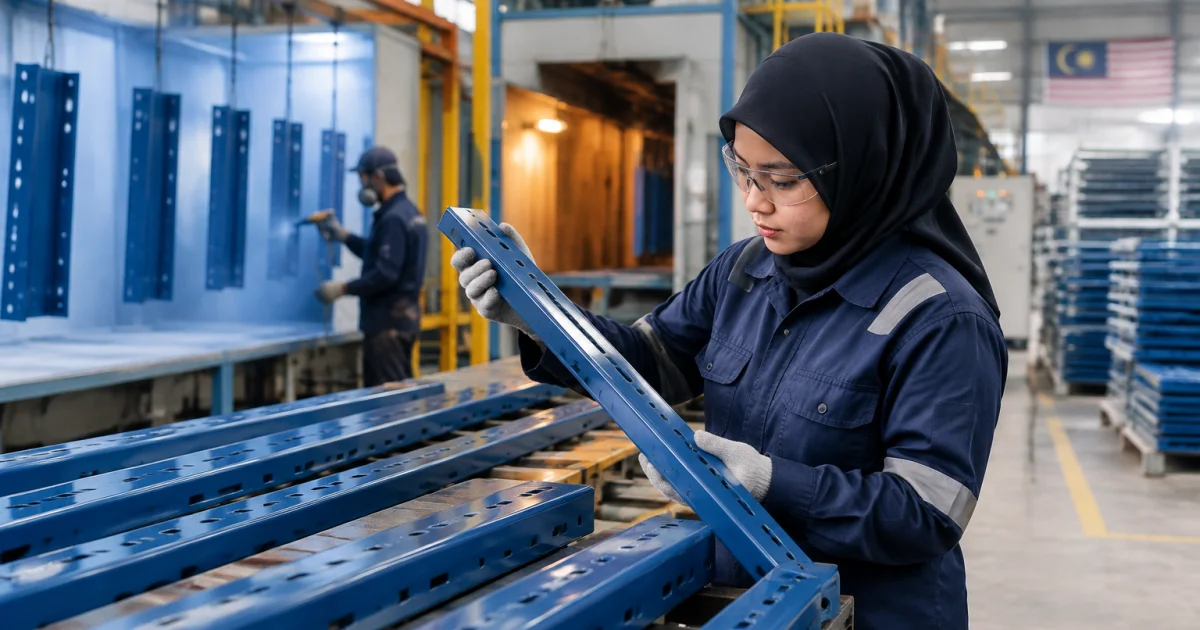
- Powder coating and curing (or other specified finishing)
Look for basic process discipline: work instructions, gauge calibration, and segregation of raw material, WIP, and finished goods. A capable manufacturer can explain how they hold hole pitch, connector geometry, and beam camber within tolerance—because these details determine whether installers can assemble without forcing parts.
Capacity, lead-time realism, and delivery readiness
Capacity is more than tonnes per month. The practical question is whether output can scale without quality dropping—and whether parts arrive installation-ready.
- Production planning: How do they schedule large batches and manage change orders?
- Standard components: Do they stock common accessories (spacers, anchors, safety pins, column protectors) to avoid site delays?
- Packing and labeling: Can they provide a sample packing list and show a kitting/labeling method that reduces missing parts?
If you are comparing a manufacturer with a trader/distributor, clarify responsibilities. A Racks Supplier Malaysia may handle design and installation while manufacturing is outsourced—but for critical projects you still need traceability to the actual factory processes and QA records.
2) Coating quality: what to verify beyond “powder coated”
Powder coating performance depends on preparation, application control, and curing—not the label. Weak coating increases corrosion risk, chips during handling, and creates sharp edges where coating cracks. This is especially visible on retail gondola or other customer-facing installations.
Surface preparation: the foundation of coating performance
Ask the manufacturer to explain their pretreatment flow. You’re looking for a controlled process that removes oils/scale and improves adhesion. Key questions:
- How is cleaning/degreasing controlled before coating?
- Is there a standardized pretreatment line (e.g., multi-stage wash) or ad-hoc wiping?
- How do they prevent flash rust between prep and coating?
- How are parts handled to avoid recontamination after prep?
For warehouse storage Malaysia sites in coastal/high-humidity areas, prep quality is a major durability driver. If the supplier can’t clearly describe their controls, treat “premium coating” claims cautiously.
Powder application and thickness control
Good coating is repeatable and measured, not purely visual. Ask:
- Do they measure coating thickness with a calibrated gauge and keep batch records?
- How do they ensure coverage on corners, edges, and inside profiles where thin spots are common?
- How do they prevent defects like orange peel, pinholes, and roughness that increase abrasion during handling?
If your order includes heavy duty pallet racking, confirm the finish is suitable for frequent forklift impact and pallet contact. Also ask which protection accessories (upright protectors, end-of-aisle guards) they recommend for long-term safety.
Oven curing discipline and batch traceability
Curing turns powder into a durable finish. Ask how they verify consistent curing across part sizes (beams, frames, brackets). Good signs include defined cure profiles, routine oven checks, and batch identification so issues can be traced and contained.
Practical coating evidence to request
You don’t need proprietary details, but you should request evidence that supports procurement approval:
- Sample coating inspection records (thickness/visual) tied to batch IDs
- A defined nonconformance process for segregation and rework
- Clear touch-up guidance for site installation
For appearance-critical areas, review finished samples under consistent lighting. For industrial sites, prioritize adhesion, edge coverage, and consistency over gloss.
3) QA process: how to validate quality before it reaches your site
QA is a working system—not a logo on a website. It prevents wrong hole patterns, mismatched connectors, inconsistent welding, and missing components that cause delays or unsafe on-site improvisation. Strong QA also protects you during handover by providing traceability.
Document control and inspection points
Ask for an overview of inspection points from incoming material to final pack-out. A typical structured approach includes:
- Incoming inspection of raw material and critical bought-out items
- In-process checks for punching, forming, welding, and fit-up
- Final inspection before coating and before packing
- Pack-out verification against the packing list / bill of materials
If they cite ISO systems (e.g., ISO 9001/14001), use that as a starting point—then ask to see controlled procedures and real recent records.
Welding quality and workmanship consistency
Weld quality affects alignment and durability. During evaluation, ask how they control:
- Welder qualification or internal competency checks
- Use of jigs/fixtures for repeatability
- Inspection criteria for defects (porosity, undercut, incomplete fusion)
Request their visual accept/reject criteria to confirm standards are defined and applied.
Dimensional control: the hidden driver of installation speed
Dimensional consistency makes installation predictable. Variations in hole pitch, upright profiles, or connector fit can slow crews and increase the risk of incorrect assembly.
Ask which measurements are critical-to-quality and how they’re checked. A strong manufacturer can explain how they verify:
- Upright hole pitch and squareness
- Beam length and end-connector fit
- Frame diagonals and overall straightness
- Base plate fit and anchor hole positions
This is especially important for heavy duty racking and for integrations with mezzanine structures, stairs, gates, or conveyors where tolerance stack-up can become a major site issue.
Nonconformance handling and corrective action
Ask: “When something is wrong, how do you stop it from repeating?” Look for a defined workflow—segregation, root cause analysis, corrective action, and verification—so defects are eliminated, not just patched.
4) What to ask and what to collect: a buyer’s checklist for large racking orders
To compare vendors fairly, standardize your RFQ clarification and evaluation requests.
Factory capability questions
- Which processes are in-house (forming, punching, welding, powder coating, packing)?
- How do they plan large batches and phased deliveries?
- How do they manage part identification and kitting to reduce missing items?
- Can they support custom layouts (including mezzanine floor systems) and future expansion?
Coating and finishing questions
- What pretreatment steps are used and how are they controlled?
- How are thickness and adhesion verified and recorded by batch?
- How are finished parts protected during storage and transport to prevent chipping?
QA and documentation to request
- Sample inspection checklist(s) used in production and final inspection
- A sample packing list aligned to the bill of materials
- Nonconformance/corrective action process overview
- Installation guidance and recommended maintenance checks
For teams planning Storage Racks Malaysia rollouts across multiple sites, ask how they maintain part compatibility and finish consistency across repeat orders. Standardization only works when the system stays consistent over time.
5) Turning evaluation into a safer shortlist (and smoother installation)
Convert your findings into a simple scoring framework across three pillars:
- Build capability: equipment, process control, capacity realism, installation readiness
- Finish performance: preparation discipline, coating control, handling protection
- QA maturity: inspection points, traceability, corrective action, documentation quality
Then weight scores to match operations. If you must scale fast, prioritize lead-time reliability and kitting accuracy. If forklift traffic is high, prioritize durability and protection accessories. If the installation window is tight, prioritize dimensional control and clear documentation to reduce on-site uncertainty.
For additional context, see Storage Racks Malaysia: Choosing Safe, Efficient Solutions for Your Warehouse. If you are still comparing system types before selecting a manufacturer, Choosing the Right Warehouse Racking System for Your Business Needs outlines key trade-offs between access, density, and throughput.
Conclusion: choose the manufacturer you can verify, not the quote you hope will work
Large racking orders are operational infrastructure. Award with confidence by evaluating what you can verify: factory capability that matches your scope, coating quality backed by preparation and inspection control, and a QA system that delivers traceable, repeatable results.
By running these checks before final award, you reduce the common causes of overruns—fit issues, missing components, coating rework, and unclear inspection evidence. You’re not only buying racking; you’re buying manufacturing control and accountability.
Frequently Asked Questions
What is the difference between a racks manufacturer and a racks supplier in Malaysia?
A racks manufacturer produces components (such as uprights, beams, frames, and accessories) in a factory and should be able to show production and QA records. A racks supplier may be a distributor or project integrator that sources from one or more factories and focuses on design, procurement, and installation. For large projects, ask who the actual factory is and request traceability to manufacturing and coating QA.
How can I assess powder coating quality for warehouse racking before I place an order?
Ask about pretreatment (cleaning and surface preparation), how coating thickness is measured and recorded by batch, and how curing consistency is controlled. Also check how finished parts are handled and packed to prevent chipping during transport and installation. Request sample inspection records rather than relying on visual samples alone.
What QA documents should a racking manufacturer provide for a large order?
At minimum, request production and final inspection checklists, packing lists aligned to the bill of materials, a nonconformance/corrective action process overview, and installation/maintenance guidance. The key is that documents are consistent, controlled, and tied to batch or order identification so issues can be traced and isolated.
Why do tolerances matter so much for pallet racking and mezzanine integrations?
Dimensional variation accumulates across many bays and levels. If hole pitch, connector fit, frame squareness, or beam length varies, installation slows down and crews may be forced to improvise—raising safety and rework risk. This is especially important when racking interfaces with a mezzanine floor, stairs, gates, or material-handling equipment.
How do racking choices support running an efficient warehouse?
Efficient warehouses balance storage density with accessibility and flow. The right system and layout can reduce travel time, improve picking accuracy, and support safe forklift movement. When evaluating manufacturers, ask whether they support layout planning (aisles, pick faces, protection accessories, expansion) in addition to producing the steel components.
Shortlisting racking manufacturers for a large order?
Mr Space provides complete in-house storage solutions—from measurement and layout planning to manufacturing, powder coating, installation, and maintenance. If you’re evaluating factory capability, coating quality, and QA documentation for a major warehouse or industrial project, we can help you specify the right system (heavy duty racking, pallet racking, shelving, mezzanine floor systems, or custom solutions) and supply clear technical and inspection support for procurement review.


