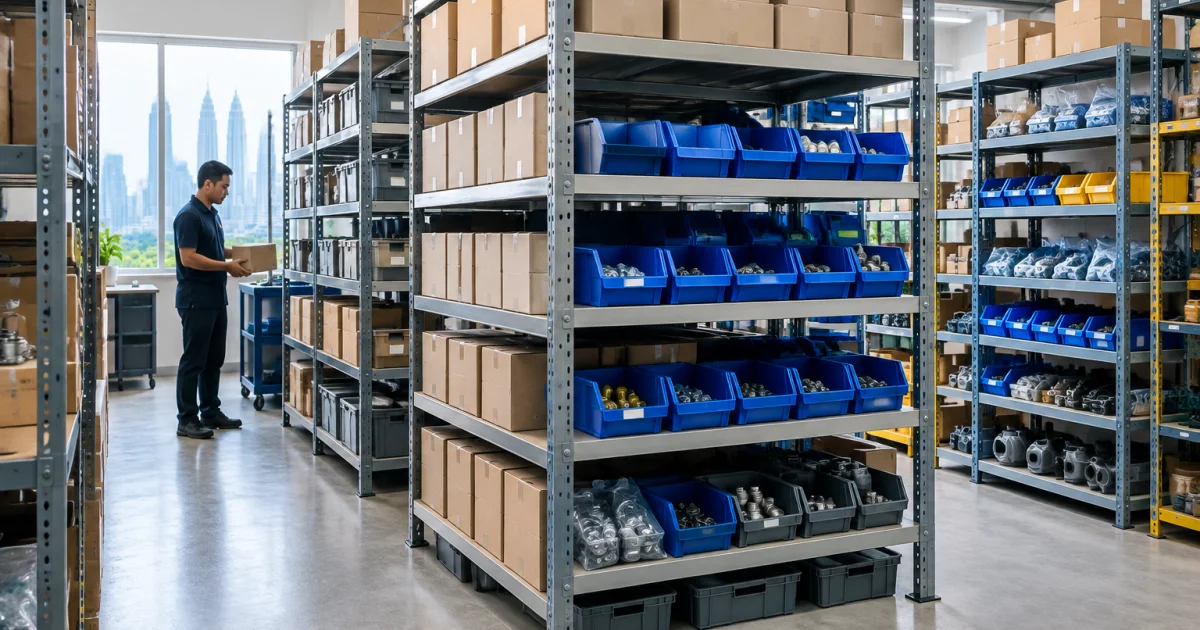
Buying a shelving rack sounds simple—until it must fit a tight storeroom aisle, carry heavy cartons safely, handle daily picking, and still expand as inventory grows. If you are sourcing Shelving Rack Selangor for a factory, storeroom, or retail backroom, this buyer’s guide covers what to measure, how to compare rack types, common mistakes to avoid, and what to ask suppliers before issuing a PO.
Built for SMEs, procurement teams, and facility supervisors, it explains essential terms (bay, upright, beam, shelf panel), duty levels (light/medium/heavy), layout basics, and a checklist you can share internally.
1) Start with your use case (not the rack model)
Most rack problems come from choosing a model before defining storage and workflow. Start by describing what you store, how items move in/out, how you pick (hand/trolley/pallet jack), and expected growth in 12–24 months. This short “storage brief” keeps comparisons objective when reviewing shelving systems from Malaysia suppliers.
Common Selangor use cases
- Factory raw materials & components: cartons, bins, parts, tools, consumables requiring access and stock visibility.
- Maintenance storeroom (MRO): many SKUs of small parts (bearings, fasteners, lubricants, PPE) needing clear organization.
- Finished goods holding: cartons needing labeling, FIFO discipline, and clean picking flow.
- Retail backroom: fast-moving cartons requiring safe handling and quick replenishment.
- Office archive/storage: clean, adjustable shelving for files and supplies.
2) Measure the right things: a simple site survey checklist
Good measurements prevent rework. You do not need full drawings, but you do need consistent dimensions plus a few photos. Measure both floor constraints and overhead obstructions.
Site survey essentials
- Clear ceiling height: measure to the lowest obstruction (lights, sprinklers, ducting, beams).
- Floor condition: note uneven slabs, cracks, drains, and slopes (affects leveling/anchoring).
- Usable footprint: measure real usable area (exclude columns, electrical panels, door swings).
- Access paths: door widths, corridor widths, turning space for trolleys/pallet jacks, loading access.
- Aisle width target: define picking method and whether ladders are used.
- Fire and safety constraints: keep access to extinguishers, electrical panels, and emergency exits.
Example: A room may be 3.2 m high, but a cable tray at 2.6 m can limit rack height and installation clearance. Proper measurement and layout planning avoids placing a rack where it cannot be assembled, adjusted, or expanded later.
3) Learn the basic shelving rack terms (so you can compare quotes)
Suppliers may use different terms for similar components. Knowing the basics helps you compare like-for-like and avoid vague “heavy duty” claims.
- Bay: one rack section (uprights/frames plus shelves or beams).
- Upright/frame: vertical posts transferring load to the floor.
- Beam/shelf support: horizontal member supporting each level (common in longspan).
- Shelf panel/decking: surface for items (steel panel, plywood, wire mesh, etc.).
- Bracing: members that stabilize the frame.
- Starter & add-on: starter stands alone; add-on shares an upright to extend a row.
- Load rating: stated per shelf (UDL) and/or per bay—confirm which applies.
When requesting quotes, insist on: load per level, number of levels, bay load, and full dimensions (height × depth × length). This is essential for fair Storage Racks Malaysia comparisons.
4) Choose the right duty category (light, medium, heavy) based on real loads
Duty should match your heaviest realistic loads and daily handling—plus future changes (new SKUs, heavier packaging, larger batch sizes). Avoid choosing based only on what you store today.
How to estimate shelf load safely
- List the heaviest items you will store and typical quantity per shelf.
- Calculate per-shelf load (item weight × quantity on that shelf).
- Add handling margin for uneven loading and “temporary” extra cartons.
- Decide if you need pallet storage instead if loads are palletized or forklift-handled.
Example: If a shelf holds 4 cartons at 15 kg and 3 parts at 35 kg, that is 165 kg. If staff frequently add extra boxes, specify a higher rating (e.g., 200–250 kg) rather than buying close to the calculated figure.
When “heavy duty rack” is the right term
Many buyers search for heavy duty rack to get higher capacity and sturdier construction for dense spare parts, tooling, or heavy cartons. However, if your unit load is a pallet and you use a forklift, you likely need pallet racking rather than shelving. A good supplier should steer you to the correct system, not oversell.
5) Pick the correct rack type for factories, storerooms, and backrooms
“Shelving rack” covers several systems. Match the type to how you store and pick items.
Boltless / light-duty shelving
Best for offices, small storerooms, and lighter backroom cartons. Fast to assemble and easy to adjust.
Good fit when: you want quick installation and frequent reconfiguration.
Watch out for: under-specifying load per level and later stacking heavier cartons.
Longspan / medium-duty shelving
For factories and storerooms storing heavier cartons, bins, and parts that are not palletized. Longer spans can reduce uprights and improve access.
Good fit when: you need a robust, adjustable system for mixed cartons and parts.
Decking choices: plywood for cartons, steel panels for easier cleaning, wire mesh for airflow and visibility.
Heavy-duty shelving (industrial)
Designed for higher per-level loads and tougher daily use (engineering stores, automotive parts, tooling, heavy inventory).
Good fit when: loads are high, items are bulky, and long-term durability matters.
When shelving is not enough: pallet racking and selective systems
If goods are palletized and moved by forklift or reach truck, move to pallet racking. Selective pallet racking is a common starting point because it provides direct access to each pallet and suits many SKU profiles.
Even if you start with “shelving,” recognizing when you actually need warehouse racking prevents unsafe workarounds and inaccurate quotations.
Retail backrooms: gondola rack vs storeroom shelving
Retailers often use gondola shelving for the sales floor and industrial shelving for the backroom. Clarify whether your Selangor project requires display gondolas, stockroom shelving, or both.
Think vertically: adding a mezzanine floor (when space is tight)
If floor space is limited but ceiling height is available, a mezzanine can add a second level for storage or work. It changes flow planning (stairs, gates, and how cartons move between levels). If a mezzanine may be a future phase, flag it early so today’s rack layout does not block a later column grid.
6) Layout planning: aisle widths, picking flow, and SKU logic
Layout should follow workflow. Often, a better layout improves productivity as much as the rack selection.
A simple workflow-based layout method
- Group SKUs by pick frequency: fast movers near entrance/dispatch; slow movers further in.
- Group by size/handling: heavy items low; small parts at ergonomic heights using bins.
- Define replenishment paths: avoid crossing inbound restocking with outbound picking where possible.
- Reserve buffer space: some empty capacity helps growth and reduces clutter.
Example: Put the top fast movers on the first rack row near the door with clear labels, and place slow-moving seasonal items higher or deeper in the room to reduce walking time and improve count accuracy.
How wide should aisles be?
It depends on picking method and equipment. Hand-picking can be tighter than cart-based or two-way traffic. When unsure, mark an aisle with tape and simulate picking with your actual trolley and carton sizes.
Ergonomics and safe picking heights
Keep frequently picked SKUs between knee and shoulder height, and place heavy items on lower levels. If step ladders are required, ensure aisle width supports safe ladder placement and confirm stability/anchoring requirements.
7) Safety, durability, and finish: what procurement should verify
Racks are long-term assets and part of your safety environment. When comparing Shelving Rack Malaysia and Selangor suppliers, look beyond price per bay.
Load rating clarity and documentation
- Confirm whether ratings are per shelf (UDL) and/or per bay.
- Confirm assumptions: number of levels, beam length, deck type.
- Confirm limitations: anchoring, leveling requirements, and recommended max heights.
If your load is point-loaded (e.g., machine feet) rather than distributed, tell the supplier—UDL ratings may not apply.
Stability and anchoring
Anchoring is often recommended for taller racks, narrow aisles, and high-traffic areas. If your site has vibration or impact risk (trolleys, pallet jacks), discuss leveling, fixing method, and protection options such as end-of-aisle guards.
Material and coating
Powder-coated finishes are common, but humid or corrosive areas may need better protection. For clean environments, choose surfaces and decking that are easier to wipe down and maintain.
Accessories that improve daily operations
- Parts bins / bin fronts for small SKUs
- Label holders for picking and audit accuracy
- Back/side mesh to reduce fall risk
- Dividers to keep SKUs separated
- Step platforms where appropriate for safe access
Accessories can be added later, but planning them early usually reduces cost and improves spacing from day one.
8) Supplier selection in Selangor: how to compare quotes and avoid common mistakes
You are buying more than steel: you are buying correct measurement, suitable load rating, proper installation, and support for expansion or repairs. Use a consistent checklist to compare suppliers fairly.
Quote comparison checklist (copy-paste for procurement)
- Exact configuration: number of bays, levels, deck type, dimensions (H × D × L).
- Load rating: per level and per bay, and whether it assumes UDL.
- Layout drawing: plan showing rack rows, aisle widths, access points.
- Installation scope: delivery, installation, anchoring, leveling, site cleanup.
- Lead time and staging: access constraints and off-hour installation options.
- After-sales support: spare parts, add-on bays, modification support.
- Safety add-ons: guards, protectors, mesh, signage (as needed).
Common buying mistakes (and how to avoid them)
- Mistake: choosing the cheapest per bay.
Fix: compare the total installed solution and specification clarity. - Mistake: underestimating load and growth.
Fix: plan for the heaviest realistic shelf load and keep buffer capacity. - Mistake: ignoring workflow.
Fix: plan aisle widths, fast/slow zones, and replenishment routes. - Mistake: forcing shelving to handle pallet loads.
Fix: if you use pallets and forklifts, request selective pallet racking options. - Mistake: no plan for vertical expansion.
Fix: confirm ceiling obstructions and note mezzanine potential early.
How Mr Space typically supports a smoother purchase
Projects run smoother when one provider covers measurement, layout planning, manufacturing, supply, installation, and maintenance. Mr Space supports complete in-house storage solutions, including site measurement, layout planning, and customized engineering where needed—useful for tight access, uneven floors, columns, or mixed SKU storage that does not fit a “standard bay” approach.
Practical buying scenarios (quick recommendations)
Scenario A: Factory maintenance storeroom with many small parts
- Goal: high SKU count, fast retrieval, clean counting.
- Suggested approach: medium-duty shelving with parts bins, label holders, and dividers; keep fast movers at ergonomic height.
- Avoid: deep shelves without dividers (creates mixed piles and “lost inventory”).
Scenario B: Retail backroom for a fast-moving store
- Goal: quick replenishment and safe carton handling.
- Suggested approach: adjustable shelving with clear aisle routes and a staging zone for inbound cartons.
- If you also need display: use gondola rack for the sales floor and separate stock shelving in the back.
Scenario C: Small warehouse area storing cartons and some heavy items
- Goal: robust storage with easy expansion.
- Suggested approach: longspan for cartons plus a heavy-duty section for heavier components; use add-on bays for simple row extension.
- Check: floor condition and anchoring needs for taller rows.
Scenario D: You are running out of floor space
- Goal: increase capacity without relocating.
- Suggested approach: go vertical (taller shelving), densify layout where safe, or plan a mezzanine if height allows.
- Check: safe access and how items move up/down (manual, trolley, lift).
What to send a supplier to get an accurate quote (and faster approval)
To reduce back-and-forth, prepare a simple RFQ pack:
- 2–6 photos of the space (corners, obstructions, doors, current racks).
- A basic sketch with dimensions (length, width, clear height, obstructions/columns).
- Item list (cartons/bins/parts), largest item dimensions, and heaviest shelf load estimate.
- Preferred number of levels and whether a staging area is needed.
- Constraints (weekend/night install, limited access, operations must continue).
With this, a supplier can propose a clearer layout and specification that is easier to approve internally.
Conclusion: buy for fit, safety, and future flexibility
A good shelving purchase is a workflow upgrade: better organization, faster picking, and safer handling. Start with the use case, measure properly, choose the right duty class, and compare quotes on configuration and installation scope—not only price. If your needs are moving toward pallet racking or vertical expansion, raise it early so your layout can evolve without expensive rework.
If you want a second opinion before committing, share your measurements and item list with a supplier who can recommend suitable shelving, heavy duty rack options, or a future-ready mezzanine plan—so you buy once and expand confidently.
Related reading: The ultimate guide to choosing a racks supplier in Malaysia.
Also useful: Is your current storage holding you back? Upgrade your shelving rack in KL & Selangor.
If you are planning retail display alongside backroom storage: The ultimate guide to gondola racks in Malaysia.
For customer-facing display layouts: Tips for selecting durable and space-saving supermarket racks in Malaysia.
Frequently Asked Questions
What information should I prepare before requesting a shelving rack quotation in Selangor?
Prepare your room measurements (usable length/width, clear height, obstructions), photos, your heaviest expected shelf load, largest item dimensions, and how you pick (by hand, trolley, or pallet jack). Also state how many levels you want per bay and whether you need space for staging or future expansion.
What is the difference between boltless shelving, longspan (medium duty), and heavy-duty shelving?
Boltless shelving is generally for lighter loads and quick reconfiguration. Longspan (medium duty) uses beams and decking to handle heavier cartons and parts with wider spans. Heavy-duty shelving is built for higher per-level loads and tougher industrial use; it is typically chosen for dense, heavy items or rough daily handling.
When should I choose pallet racking instead of shelving racks?
Choose pallet racking when your unit load is a pallet and you handle goods with forklifts or reach trucks. Shelving is meant for hand-picked cartons, bins, and parts. If you are routinely lifting pallets onto shelving or stacking pallets on the floor, it is a sign you should evaluate selective pallet racking or another pallet system for safer handling and better access.
How do I know if my rack needs to be anchored to the floor?
Anchoring is commonly recommended for taller racks, narrow aisles, high-traffic areas, or locations with impact risk from trolleys and pallet jacks. The decision depends on rack height-to-depth ratio, floor condition, and how the rack will be used. Ask the supplier to confirm stability assumptions and installation method for your specific layout.
Can I combine shelving racks with a mezzanine floor to increase capacity?
Yes. Many facilities increase capacity by adding a mezzanine floor for slow-moving inventory or secondary operations, while keeping fast-moving items on ground-level shelving. The key is planning safe access, load requirements, and how cartons move between levels. If a mezzanine may be a future phase, mention it early so the ground-level layout stays compatible.
Need help specifying the right shelving racks for your Selangor site?
Mr Space supports factories, storerooms, and backrooms with end-to-end storage solutions—from site measurement and layout planning to in-house manufacturing, supply, professional installation, and maintenance. Whether you need boltless shelving, medium-duty longspan, heavy-duty shelving, retail gondola racks, pallet racking, or a future-ready layout that can work with a mezzanine concept, our team can help you choose a configuration that fits your loads and workflow.
Share your space dimensions and what you store, and we will help you shortlist a practical rack specification for quotation and internal approval.


