
Boltless racks have long been popular with Malaysian SMEs and facility teams because they’re modular, quick to assemble, and easy to expand. Today, however, what used to be treated as a “simple shelving” purchase is increasingly handled like a small engineering job: clearer load expectations, tighter component tolerances, better anchoring decisions, and more disciplined handover checks.
If you’re comparing installers or upgrading a storeroom layout, these shifts matter. A Boltless Racking System Malaysia project often fails not because the concept is wrong, but because installation practices and component standards don’t match the real use case—manual picking today, heavier cartons next quarter, or an eventual move into a light warehouse racking system zone.
This guide explains what’s changing, what to ask your supplier, and how to keep boltless bays safe, square, and scalable.
Why installation is becoming more rigorous (even for “simple” boltless racks)
Several operational realities are pushing boltless installations toward more professional methods:
- Higher variability in loads: SMEs often scale from light inventory to heavier SKUs, bulk cartons, or spare parts. The same bay may face different point loads over time.
- Tighter space planning: Higher-density, taller storerooms increase the consequences of out-of-level bases, uneven engagement, or weak lateral stability.
- Workflow pressure: Faster picking and frequent reconfiguration mean more bumps and handling. Installations must tolerate change without losing stability.
- Integration with broader racking planning: Boltless areas are increasingly placed near pallet racking, staging, or below a mezzanine floor, changing floor, clearance, and impact considerations.
As a result, more teams request site measurement, layout input, and a documented installation approach—especially for taller bays or long continuous rows.
What’s changing in installation practices (what good installers do now)
Quality today is less about speed and more about repeatable steps that deliver consistent geometry and predictable capacity. When you evaluate a Boltless Rack Malaysia supplier or installer, look for the practices below.
1) Floor assessment and shimming as a standard step
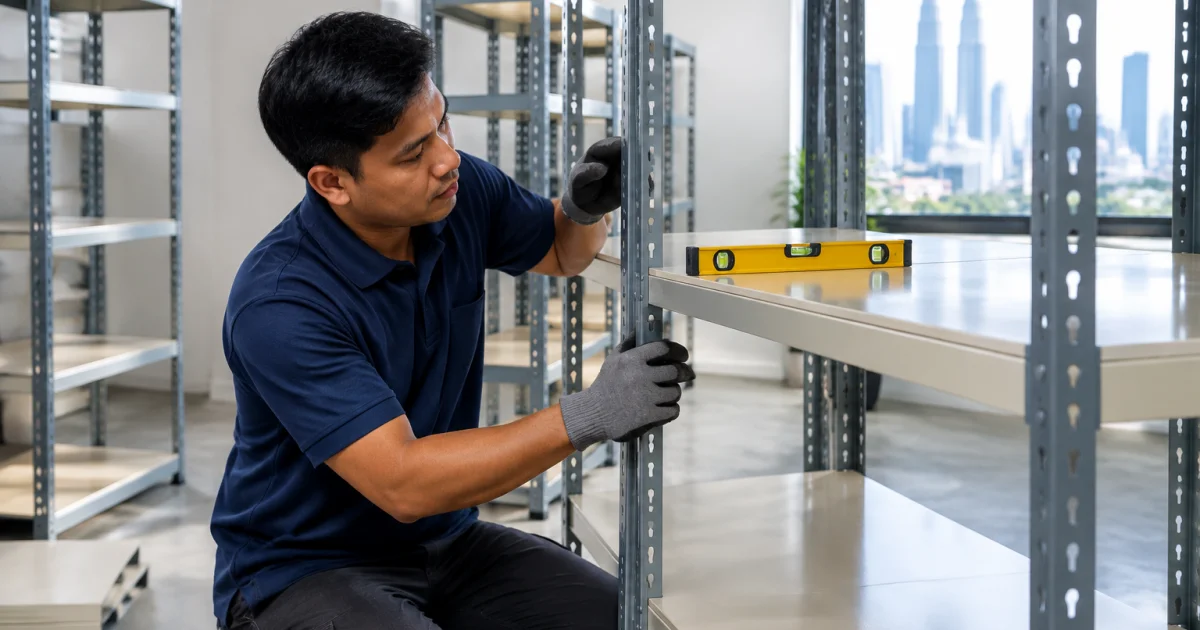
Storeroom floors are rarely perfectly flat. A professional crew checks level across the full run (not just a single bay) and shims uprights as needed to prevent “progressive lean,” where small errors accumulate along the row.
Ask how they handle:
- Minor undulations (proper shims vs improvised packing)
- Drain channels or expansion joints
- Areas near roller shutters where water ingress can degrade flooring over time
2) Squareness and plumb checks during build—not only at the end
Better installers check plumb and squareness while frames are still adjustable. Waiting until the system is complete (or loaded) makes correction slower and less precise—especially on taller frames or long rows where small deviations compound.
3) Clear rules for bracing, row ties, and bay-to-bay connection
Older installations often apply bracing inconsistently. Modern practice treats stability as a system property, not a single-bay feature. A competent installer should explain when they use:
- Back bracing / cross bracing to resist racking (side sway)
- Row spacers or ties to keep long lines straight and distribute lateral forces
- Wall fixing when freestanding stability isn’t sufficient for the height or usage
There’s no universal rule for every site, but there should be a consistent rationale tied to height, depth, aisle interaction, and load pattern.
4) Anchoring decisions based on use, not habit
Some boltless systems can be freestanding; others should be anchored. The right answer depends on height-to-depth ratio, exposure to traffic and impacts, building conditions, and whether the configuration is likely to be climbed, leaned on, or frequently reconfigured.
What’s changing is that good installers document why they anchor (or don’t). If racks sit near material-handling routes or you’re building tall, narrow bays, anchoring should be an explicit discussion—not an afterthought.
5) Handover checks and basic user training
More suppliers now include a simple handover: confirming shelf engagement, verifying that supports are fully seated, and briefing users on safe loading (heaviest items low, avoid point-loading on thin deck panels, and label maximum loads clearly).
This is particularly helpful for SMEs where staff turnover can make safe-loading “tribal knowledge” unreliable.
Component standards: where inconsistencies show up (and how to spot them)
When buyers say “quality,” they often focus on thickness or paint finish. Those matter, but the bigger practical issue is component consistency—how reliably parts fit, lock, and share load across the bay and across multiple bays in a row.
Uprights and perforations: tolerance matters
Boltless systems rely on slots, keyholes, or perforations to locate shelves and supports. If tolerances vary, parts may seat “almost” correctly, leading to partial engagement that can slip under vibration or repeated loading/unloading.
During evaluation, check:
- Whether shelf levels align across bays without forcing parts
- If there is play (wobble) after assembly
- Whether shelves/supports fit consistently across uprights from the same batch
Beams, shelf supports, and locking features
Even if a system is “boltless,” it should still have secure engagement or positive locking to reduce accidental dislodging during daily picking.
Ask the supplier to explain the load path: how the shelf transfers load into supports, then uprights, and finally the floor. If they can’t explain it simply, treat that as a warning sign.
Decking choices: steel panels, particle board, wire mesh—fit and use-case alignment
Decking affects load distribution and suitability for the environment. Facilities increasingly choose decking based on inventory type and conditions:
- Steel panels for durability and easy cleaning in industrial storerooms
- Board decking when protecting product finish matters (and where humidity is managed)
- Wire mesh for airflow (and where small items won’t fall through)
Good installers also check that decking sits flush and is supported correctly, rather than leaving gaps or uneven bearing points.
Finish and corrosion protection as a practical standard
Powder coating and surface preparation affect longevity, especially in humid areas, near loading bays, or in sites with frequent washdowns. You don’t need exotic specifications—just consistent coverage, clean edges, and minimal burrs, because thin coating and sharp edges often become early failure points.
How to evaluate a supplier or installer (BOFU checklist for facility teams)
Near purchase, the best decision often comes down to clarity and discipline—not the lowest quote. Use this checklist to compare Racks Supplier Malaysia candidates on factors that reduce risk.
Pre-install: questions to ask before you sign
- What load is the system designed for? Request guidance by shelf level and bay configuration, not just generic claims.
- What is included in the scope? Clarify site measurement, layout recommendation, delivery, installation, anchoring hardware, and clean-up.
- How will you handle uneven floors? Look for a real method (level checks, shimming plan), not “we’ll adjust on site.”
- Can you support future expansion? Confirm compatible components will remain available if you add bays later.
During install: what to observe on-site
- Are bays checked for plumb/level as they go?
- Are supports fully seated with consistent engagement?
- Is the sequence controlled (frames first, then leveling, then shelves)?
- Is there a plan for long rows (ties, spacing, straightness checks)?
Post-install: handover items worth requesting
- A simple bay layout and shelf-level plan (even one page)
- Guidance on safe loading and reconfiguration limits
- Advice on periodic checks (e.g., after reconfiguration or an impact event)
If your facility also uses pallet racks or plans heavier storage zones, align boltless areas with a broader warehouse racking strategy. For background, see this guide to selecting the right racking system and how to choose a warehouse racking system for business needs.
When boltless is the wrong choice (and what to consider instead)
Boltless shelving is well-suited to cartons, spare parts, and manual picking. But many sites push it beyond its sweet spot. Consider alternatives when:
- You’re handling pallets or frequent forklift interaction: Use engineered pallet racking rather than over-sizing boltless bays.
- Loads are very heavy or impact risk is high: Choose heavy-duty systems designed for industrial use.
- You need vertical space as a platform: A mezzanine floor solution is typically safer and more scalable than stacking tall shelving lines.
Boltless can be part of a complete racking system, but it shouldn’t replace heavy-duty zones. If you’re planning a mixed facility (boltless for small parts, pallet racks for bulk), this may help: ways the right warehouse racking system can reduce operational costs.
Conclusion: buy boltless like a system, not a commodity
The biggest change in Boltless Racking System Malaysia projects is mindset. Buyers are treating boltless shelving as a modular system that needs correct geometry, consistent components, and a disciplined installation method—especially as SMEs scale and storerooms become denser.
When you compare quotes, don’t only compare bays and shelf levels. Compare floor preparation, alignment checks, bracing/anchoring logic, component consistency, and handover discipline. These “invisible” details are what keep racks straight, safe, and easy to expand long after installation.
Frequently Asked Questions
Do boltless racks need to be anchored to the floor?
Not always. Anchoring depends on height-to-depth ratio, the length of the row, exposure to knocks (trolleys, pallet jacks), and how the shelving will be used. If bays are tall, narrow, placed in high-traffic aisles, or likely to be climbed or leaned on, anchoring (or wall fixing) is often a safer choice. A good installer should explain the rationale site-by-site.
How can I tell if boltless shelves are properly engaged during installation?
Proper engagement means the shelf supports or beams are fully seated in the upright slots/keyholes with no partial hanging or uneven contact. Signs of poor engagement include wobble, visible gaps at connection points, shelves that sit unevenly, or parts that require excessive force to fit. Ask for a plumb/level check and a quick walk-through before loading inventory.
What components should be consistent across a boltless racking project?
At minimum, uprights, perforations/slots, shelf supports, locking features, decking panels, and base plates (if used) should fit reliably across all bays. Consistency matters because mixed tolerances can cause partial engagement and instability, especially in long continuous rows or taller configurations.
When should I switch from boltless shelving to a warehouse racking system?
If you are storing pallets, using forklifts in the same zone, handling very heavy loads, or experiencing frequent impacts, you should consider engineered pallet racking or heavy-duty solutions instead of oversizing boltless bays. Boltless is best for manual picking, cartons, and parts storage; heavier and mechanised workflows generally require purpose-designed warehouse racking systems.
Can Mr Space support mixed storage layouts, like boltless racks plus mezzanine floors?
Yes. Mr Space provides end-to-end storage solutions—from light duty and boltless racking to pallet racking and mezzanine floor systems—covering site measurement, layout planning, manufacturing, supply, installation, and maintenance. This helps ensure boltless areas integrate safely with heavier zones and future expansion plans.
Plan a safer boltless layout with Mr Space
If you’re comparing boltless systems or upgrading an existing storeroom, Mr Space can help you translate your inventory, floor conditions, and workflow into a practical racking layout—then manufacture and install it with consistent components and professional site checks.
Talk to our team about light duty and boltless racking, or how to integrate boltless bays with pallet racking and mezzanine floor solutions for a complete storage system.


