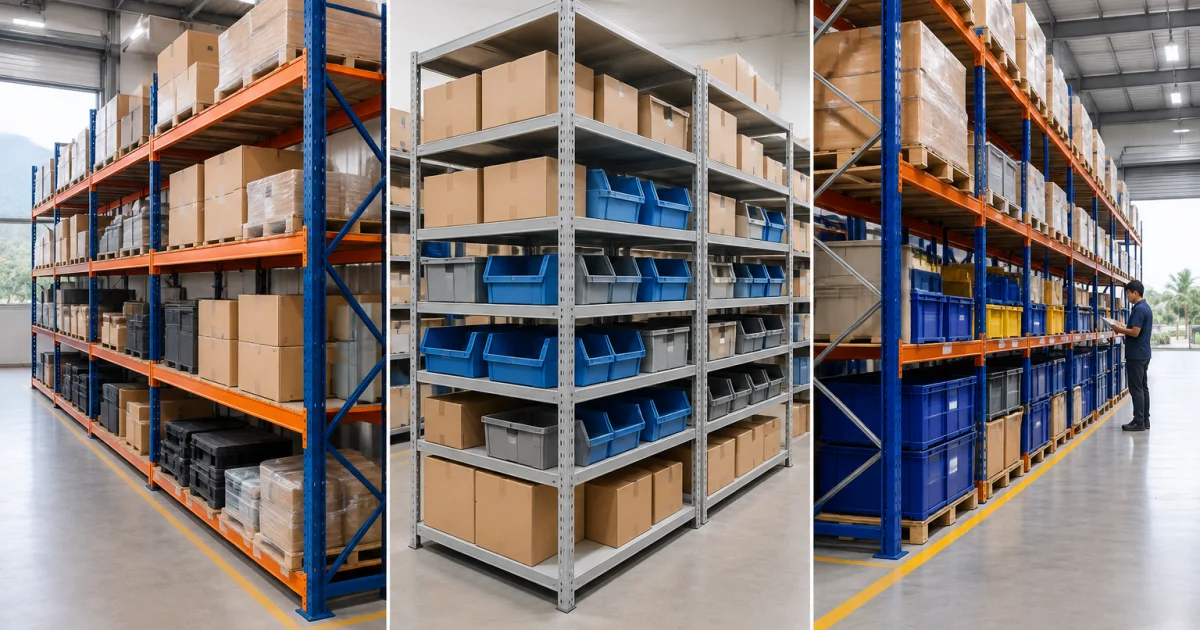
When operations teams search for Shelving Rack Malaysia, they’re rarely looking for “a rack” in general—they’re trying to fix specific issues: damaged cartons, missing parts, congested aisles during picking, or a storeroom that can’t scale with growth.
Most shelving projects go wrong when choices are made by “capacity on paper” instead of how work actually happens—receiving, put-away, replenishment, picking, cycle counting, and housekeeping. Longspan, boltless, and industrial shelving can all be right, but each becomes expensive (or risky) when forced into the wrong use case.
This guide compares the practical differences and gives you a simple decision framework you can use with your internal team or a racking system supplier in Malaysia.
Start with the workflow, not the catalogue
Before comparing shelf types, align on three operational inputs. These usually matter more than brand names or a single “kg per level” number.
- Unit load: Loose items in bins, inner boxes, cartons, or long/heavy parts? What’s the largest and heaviest typical SKU?
- Access pattern: Direct access to every SKU daily, or mainly reserve storage with occasional access?
- Change frequency: Will shelf heights and bay widths stay fixed, or will you re-slot often as SKUs change?
If you’re unsure, do a quick “fast walk” audit: observe one put-away and one picking cycle end-to-end. Note where people slow down, handle cartons twice, or stage items on the floor—those points indicate whether you need more adjustability, more stiffness, or a more engineered shelving setup.
Longspan shelving: the balanced choice for cartons and mixed parts
Longspan is often the “sweet spot” in storerooms and back-of-house environments because it balances clear span, configuration flexibility, and shelf surface options (steel panels, plywood, wire decking depending on design). It’s commonly chosen when you want fewer uprights in the way and you’re storing cartons, bins, or awkward-shaped components.
Where longspan performs best
- Carton storage and kitting: Wider bays reduce vertical interruptions, making staging and pick faces easier to manage.
- Maintenance, repair, and operations (MRO): Mixed parts, tools, spare motors, and consumables fit the format well.
- SME growth phases: Scales as SKU profiles evolve while handling remains mostly manual.
My opinion on longspan trade-offs
Longspan is versatile, which is also its risk: teams treat it like a “do-everything system.” If you load longspan like pallet racking, it may not fail immediately, but deflection, bowed shelves, and long-term stability issues can follow. Keep loads within the intended range and maintain good shelf surfaces so cartons don’t deform or snag.
For a concrete product example, Mr Space offers longspan options like the 2100 Series Longspan Shelving Rack (Plywood) commonly specified for carton and mixed-inventory storage.
Boltless shelving: fast to deploy, great for light-to-medium duty—but watch the boundaries
Boltless Rack Malaysia searches usually come from teams who want quick installation, flexible shelf heights, and a cost-effective solution for storerooms, offices, workshops, and retail backrooms. Boltless systems can be very practical when you need many bays installed quickly with minimal disruption.
Where boltless makes sense
- Document archives and office storage: Neat, stable, and easy to reconfigure as volumes change.
- Light parts and consumables: Bins, small cartons, packaging materials, and non-bulky supplies.
- Satellite storerooms: Standardized shelving across multiple rooms or departments.
Common boltless mistakes (that create hidden cost)
- Underestimating point loads: “Evenly distributed” ratings don’t reflect dense motors, gearboxes, or stacked fastener bins that concentrate weight.
- Ignoring aisle impact: If trolleys or pallet jacks operate nearby, knocks are inevitable; lighter frames can drift out of alignment sooner.
- Letting shelf surfaces become the weak link: Warped boards or damaged panels snag cartons and increase handling time and product damage.
Rule of thumb: choose boltless when the workflow is light and the main risk is clutter, not weight. If the area is trending more “industrial” (heavier parts, higher bays, more traffic), plan an upgrade path early rather than waiting for an urgent replacement.
Industrial shelving: when stability, height, and discipline matter
Industrial shelving is the more engineered end of the shelving spectrum. It’s the right conversation when you need taller bays, higher capacity, more rigidity, and consistent performance in industrial conditions. If your discussions include topics like bracing, anchors, bay load, floor flatness, or impact risk, you’re likely beyond basic storeroom shelving.
In Malaysia, industrial projects also often pair shelving with wider space-optimisation moves—like adding a mezzanine floor over picking/packing zones to separate people flow from storage, or to add a second level for light goods while keeping heavy goods below. This isn’t a shelving “type,” but it can change which system is most efficient.
Signals you should consider an Industrial Shelving System Malaysia spec
- You need height: As you go higher, stability and installation quality become more critical.
- You have frequent replenishment: Repeated loading/unloading increases wear; you want a system that stays square and true.
- Traffic is industrial: Forklifts, reach trucks, or frequent pallet jack movement increases impact risk.
- Inventory is heavy or dense: Tooling, mould components, bearings, fasteners, and WIP containers can be deceptively heavy.
How industrial shelving differs in practice
The difference is not just “higher capacity.” It’s consistency: shelves stay level, uprights stay aligned, and you can design around SOPs (labeling, binning, replenishment lanes, housekeeping). That consistency pays back in faster cycle counts, fewer pick errors, and fewer “temporary” floor stacks that become permanent.
If you’re in a heavy-duty environment but still need shelf-based storage (not pallets), consider a dedicated heavy-duty shelving line such as Mr Space’s 3800 Series Heavy Duty Shelving Rack.
A practical decision framework (what I’d use to choose in 30 minutes)
Use the framework below as a starting point, then validate with site measurement and load requirements.
| Decision factor | Boltless | Longspan | Industrial shelving |
|---|---|---|---|
| Typical use | Light storerooms, office/records, backroom supplies | Cartons, bins, mixed parts, kitting | Heavy/dense inventory, taller bays, industrial traffic |
| Adjustability | High | High | High, but often engineered around SOP |
| Resistance to impact & drift over time | Lower | Medium | Higher |
| Best for fast expansion | Good (quick deployment) | Very good (modular and versatile) | Good (but plan layout and installation carefully) |
| When it becomes the wrong choice | When loads get dense/heavy or traffic increases | When used like pallet racking or pushed beyond intended loads | When inventory is light and you’re over-specifying |
If you’re torn between two options
- Boltless vs longspan: Choose longspan if cartons and mixed shapes dominate or you want wider clear spans for picking. Choose boltless if it’s truly light-duty, frequently reconfigured, and mostly hand-picked.
- Longspan vs industrial shelving: Choose industrial shelving if you need height, long-term rigidity, or the area behaves like a warehouse zone (high replenishment frequency, equipment movement, dense metal inventory). Choose longspan for flexible mid-duty storage with mainly manual handling.
Integrating shelving with the bigger “racking system” plan
Shelving decisions get easier when you place them inside a broader storage layout. Many sites use a hybrid: shelves for piece picking and parts, and pallet racking for reserve stock.
If you’re running pallets in the same facility, don’t force shelving to solve pallet problems. A warehouse racking system (selective pallet racks, drive-in, push-back, or gravity flow—based on SKU velocity and selectivity needs) can reduce double-handling and prevent pallets being broken down too early.
Two practical integration tips:
- Separate pick and reserve logically: Put shelving near packing/dispatch for fast movers; keep pallet racking for bulk and reserve to reduce congestion and improve discipline.
- Use vertical space intentionally: If you’re outgrowing floor space, a mezzanine floor can create a second level for light items, e-commerce packing, or slow movers while keeping heavy goods and equipment on ground level.
For broader context, you may also find it useful to read Choosing the right warehouse racking system for your business needs and Storage racks Malaysia: choosing safe, efficient solutions for your warehouse.
Installation, safety, and lifecycle: what matters after the purchase order
It’s tempting to treat shelving as “furniture,” but in industrial environments it behaves more like equipment. Lifecycle cost usually comes from rework, damaged goods, and lost productivity—not the initial supply.
What I would insist on for any shelving project
- Clear load assumptions: Define what “per shelf” means (evenly distributed vs concentrated) and disclose dense metal items upfront.
- Floor condition awareness: Uneven floors create leaning bays and misaligned shelves; shimming and correct installation matter.
- Anchoring and stability where appropriate: Especially for taller bays or areas with frequent nearby movement.
- Aisle discipline: Even the right shelving performs poorly if aisles are too tight for passing and safe staging.
- Maintenance checks: Periodic inspection for bent posts, damaged decks, loose components, and shifting alignment.
The best supplier isn’t the one with the widest catalogue; it’s the one who can measure, design around your workflow, manufacture consistently, and install cleanly—so you don’t spend the next year “fixing” the system with improvised add-ons.
Conclusion: choose the shelving that protects your workflow
Choosing between boltless, longspan, and industrial shelving shouldn’t be guesswork. Start with the work: what you store, how often you touch it, and what happens around the shelving (traffic, height, replenishment). Then match the system to the environment.
If you want the quick summary:
- Boltless is best for light-duty, high-flexibility storerooms and office/backroom use.
- Longspan is the balanced choice for cartons and mixed parts where manual picking dominates.
- Industrial shelving is for heavier, taller, busier industrial zones where rigidity and long-term stability pay back.
When you treat shelving as part of a system—sometimes alongside pallet racking or a mezzanine floor—you get a layout that scales with growth instead of fighting it.
Frequently Asked Questions
What is the difference between longspan shelving and boltless shelving?
Boltless shelving is typically designed for lighter loads and quick manual assembly with frequent reconfiguration. Longspan shelving generally provides wider clear spans and a sturdier format that suits cartons, bins, and mixed inventory where you want fewer uprights interrupting access.
When should I choose an Industrial Shelving System Malaysia specification instead of standard shelving?
Consider an industrial shelving specification when you need taller bays, higher rigidity, and consistent performance in industrial conditions—such as dense/heavy parts, frequent replenishment, or nearby equipment movement. It’s also a better fit when you want a more engineered approach to anchoring, stability, and long-term alignment.
Is boltless shelving suitable for spare parts and maintenance stores?
It can be, if most items are light and handled manually (bins, consumables, small cartons). If the store carries dense or concentrated loads (motors, tooling, fasteners in heavy bins) or the area sees frequent knocks from trolleys/pallet jacks, longspan or heavier-duty industrial shelving is often a safer long-term choice.
How do I estimate the right shelf capacity without overbuying?
Start with the heaviest typical load per shelf level and whether the load is evenly spread or concentrated. Then add a sensible buffer for peak periods and future SKU changes. A good approach is to review a sample of your fastest movers and heaviest items, confirm storage method (carton, tote, bin), and validate assumptions with your supplier during layout and design.
Can shelving be combined with pallet racking or a mezzanine floor in the same warehouse?
Yes. Many facilities use shelving for piece-picking and parts, while pallet racking holds reserve stock or bulk pallets. A mezzanine floor can add a second level for light goods, packing, or slow movers, improving space utilisation without expanding the building footprint.
Need a shelving layout that fits your inventory and workflow?
Mr Space provides end-to-end storage solutions—from site measurement and layout planning to local manufacturing, supply, and professional installation. If you’re comparing boltless, longspan, and industrial shelving (or integrating shelving with pallet racking or a mezzanine floor), we can recommend a configuration that matches your load needs, access requirements, and growth plans.


